Carbon fiber has become one of the most important materials in modern engineering. From aerospace structures and racing vehicles to medical equipment, drones, robotics, and premium consumer products, carbon fiber is widely recognized for its exceptional strength-to-weight ratio.
Among the different types of carbon fiber products available today, dry carbon fiber is often considered the highest-performance option. It is lighter, stronger, more stable, and more consistent than traditional wet-layup carbon fiber. For industries where every gram matters, dry carbon fiber can provide a clear performance advantage.
But what exactly is dry carbon fiber? How is it made? Why is it more expensive than wet carbon fiber? And when should buyers choose dry carbon fiber instead of other carbon fiber manufacturing methods?
This guide explains what dry carbon fiber is, how prepreg carbon fiber works, how autoclave carbon fiber parts are manufactured, and what buyers should know before choosing a dry carbon fiber manufacturer.

What Is Dry Carbon Fiber?
Dry carbon fiber refers to carbon fiber composite parts manufactured using prepreg carbon fiber materials that are cured under controlled temperature and pressure, typically inside an autoclave.
Unlike traditional wet carbon fiber production, where liquid resin is manually applied to carbon fabric during the layup process, dry carbon fiber uses carbon fiber fabric that has already been pre-impregnated with a precise amount of resin. This material is called prepreg carbon fiber.
In simple terms, dry carbon fiber is not “resin-free.” It still contains resin, but the resin is added in a controlled way before the part is laid into the mold. This allows manufacturers to control the fiber-to-resin ratio much more accurately than manual wet layup.
Because the resin content is tightly controlled, dry carbon fiber components can achieve:
- Higher fiber volume fraction
- Lower unnecessary resin content
- Reduced weight
- Higher stiffness
- Better strength consistency
- Improved dimensional accuracy
- Cleaner surface finish
- Fewer internal defects
For this reason, dry carbon fiber is widely used in aerospace, motorsports, high-performance automotive parts, drones, medical devices, and premium sporting equipment.
When buyers search for what is dry carbon fiber, they are usually trying to understand whether it is simply a visual upgrade or a real performance material. The answer is clear: dry carbon fiber is not just about appearance. It is a manufacturing method designed for higher mechanical performance, lighter weight, and better repeatability.
Why Is It Called “Dry” Carbon Fiber?
The term “dry carbon fiber” can be confusing because the final material is not actually dry in the sense of having no resin.
Carbon fiber parts always need a resin matrix. The resin binds the carbon fibers together, transfers loads between fibers, protects the fibers from damage, and helps form a stable composite structure.
The word “dry” mainly comes from the manufacturing process.
In traditional wet carbon fiber layup, technicians place dry carbon fiber cloth into a mold and then manually apply liquid resin. The fabric becomes visibly wet during the process. Resin may be brushed, rolled, poured, or infused depending on the specific production method.
In dry carbon fiber manufacturing, the carbon fiber fabric is already impregnated with resin before it arrives at the factory floor. The technician does not need to manually saturate the fabric with liquid resin during layup. The prepreg sheet feels relatively dry, clean, and tacky rather than wet and messy.
That is why the industry often uses the term “dry carbon fiber.”
This difference may sound small, but it has a major influence on the final part quality. Manual resin application can lead to resin-rich areas, dry spots, air bubbles, and inconsistent laminate thickness. Prepreg carbon fiber significantly reduces these problems because the resin content is engineered and controlled before production begins.
What Is Prepreg Carbon Fiber?
To understand dry carbon fiber, it is important to understand prepreg carbon fiber.
Prepreg stands for pre-impregnated carbon fiber.
In a prepreg manufacturing facility, carbon fiber fabric or unidirectional carbon fiber tape is combined with a controlled amount of resin, usually an epoxy resin system. The resin is partially cured to a stable state, which allows the material to be stored, transported, cut, and laid into molds before final curing.
The key advantage of prepreg carbon fiber is control.
With prepreg materials, the resin content, fiber alignment, resin distribution, and material thickness are much more consistent than in many wet layup processes.
Prepreg carbon fiber usually offers:
- Precise resin content
- Excellent fiber alignment
- Consistent thickness
- Strong bonding between layers
- Better repeatability
- Cleaner production
- Improved mechanical properties
This is one of the main reasons dry carbon fiber parts are often preferred for demanding engineering applications.
In many high-performance industries, prepreg carbon fiber is considered a premium composite material because it allows manufacturers to produce strong, lightweight, and repeatable parts with fewer defects.
How Dry Carbon Fiber Part Is Manufactured
Dry carbon fiber manufacturing is a controlled composite production process. While each project may have different requirements, most dry carbon fiber parts follow a similar production workflow.
Step 1: Material Selection
The process begins with selecting the right carbon fiber material.
Common carbon fiber options include:
- Plain weave carbon fiber
- Twill weave carbon fiber
- Unidirectional carbon fiber
- Spread tow carbon fiber
- Multiaxial carbon fiber fabrics
Each material has different advantages.
Twill weave carbon fiber is often used for visible parts because it has a premium appearance and can conform well to curved surfaces. Plain weave carbon fiber provides good stability and balanced appearance. Unidirectional carbon fiber is used when strength and stiffness are required in a specific direction.
The choice depends on the part’s function, appearance requirements, loading conditions, and budget.
For example, an automotive interior trim part may prioritize surface finish and weave appearance, while a structural drone arm may prioritize stiffness, fatigue resistance, and weight reduction.
Step 2: Mold Preparation
Before prepreg layup begins, the mold must be carefully prepared.
A high-quality mold is essential for producing accurate dry carbon fiber parts. The mold surface directly affects the final part’s dimensions, surface quality, and repeatability.
Mold preparation may include:
- Cleaning the mold surface
- Applying release agent
- Checking mold alignment
- Inspecting surface defects
- Verifying temperature resistance
For high-end carbon fiber manufacturing, mold quality is extremely important. Even a small mold defect can be transferred to the finished carbon fiber part.
Step 3: Prepreg Cutting
Prepreg carbon fiber sheets are cut according to the design pattern.
For simple parts, cutting may be done manually. For more complex or high-volume projects, CNC cutting machines may be used to improve accuracy and reduce material waste.
Cutting patterns must consider:
- Fiber direction
- Ply orientation
- Overlap areas
- Edge trimming allowance
- Structural reinforcement zones
This step is especially important for structural carbon fiber parts because fiber direction directly affects strength.
Step 4: Prepreg Layup
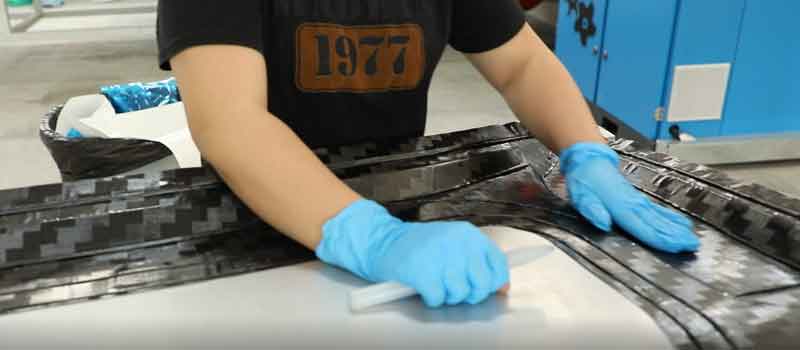
Technicians place each prepreg layer into the mold according to the layup schedule.
The layup schedule defines the number of layers, fiber orientation, stacking sequence, and reinforcement areas.
Carbon fiber is anisotropic, meaning its mechanical properties depend heavily on fiber direction. A part may be extremely strong in one direction but weaker in another if the laminate design is not optimized.
Common ply orientations include:
- 0 degrees
- 45 degrees
- 90 degrees
- -45 degrees
By combining different orientations, engineers can design parts that resist bending, twisting, impact, and tensile loads.
This is one of the biggest advantages of carbon fiber manufacturing. Instead of using the same material properties in all directions, engineers can design strength exactly where it is needed.
Step 5: Vacuum Bagging
After layup, the laminate is covered with release film, breather fabric, and vacuum bagging film.
The entire assembly is sealed, and vacuum pressure is applied.
Vacuum bagging helps:
- Remove trapped air
- Compact the laminate
- Improve layer bonding
- Reduce voids
- Control excess resin flow
- Improve surface quality
This step is critical because air trapped between layers can create voids. Voids reduce strength, fatigue resistance, and long-term reliability.

Step 6: Autoclave Curing
The vacuum-bagged laminate is placed inside an autoclave.
An autoclave is a specialized pressure vessel that applies controlled heat and external pressure during curing.
During autoclave curing, temperature activates the resin system, while pressure consolidates the laminate and reduces internal voids.
Typical autoclave curing conditions vary depending on the prepreg resin system, but the process usually involves:
- Controlled heating rate
- Specific curing temperature
- Defined pressure level
- Holding time
- Controlled cooling rate
This process allows resin to flow evenly, bond the layers, and form a dense composite structure.
Autoclave carbon fiber parts are known for their low porosity, excellent surface finish, and high mechanical performance.

Step 7: Demolding
After curing and cooling, the part is removed from the mold.
This step must be done carefully to avoid damaging the surface, edges, or structural areas.
A well-designed mold and proper release system make demolding easier and help maintain part quality.
Step 8: Trimming, Drilling, and Finishing
Once the part is demolded, it usually requires secondary processing.
This may include:
- CNC trimming
- Edge sanding
- Drilling
- Bonding
- Clear coating
- Painting
- Polishing
- Inspection
For visible carbon fiber parts, finishing is especially important. Buyers often expect dry carbon fiber parts to have a clean weave pattern, glossy or matte surface, and premium appearance.
For structural parts, dimensional accuracy and mechanical performance are more important than appearance alone.
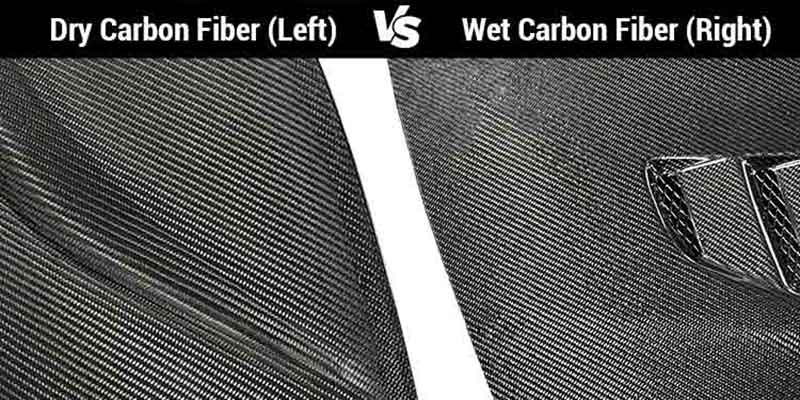
Dry Carbon Fiber vs Wet Carbon Fiber
One of the most common buyer questions is:
What is the difference between dry carbon fiber and wet carbon fiber?
Both materials use carbon fiber and resin. The main difference is how the resin is introduced and controlled.
Wet carbon fiber is usually made by placing dry carbon fabric into a mold and manually adding resin. This method is more affordable and suitable for many general-purpose parts.
Dry carbon fiber uses prepreg carbon fiber with pre-controlled resin content. The part is typically cured under vacuum and pressure, often in an autoclave.
| Feature | Dry Carbon Fiber | Wet Carbon Fiber |
|---|---|---|
| Weight | 20–40% lighter | Baseline |
| Fiber Volume Fraction | 55–70% | 35–50% |
| Tensile Strength | Up to 30–50% higher* | Baseline |
| Stiffness | Higher | Moderate |
| Resin Content | Lower | Higher |
| Void Content | <1–2% | Typically 3–8% |
| Consistency | Excellent | Operator-dependent |
Wet carbon fiber can still be useful for decorative covers, simple panels, prototypes, and cost-sensitive projects.
However, when the goal is maximum strength-to-weight ratio, consistent quality, and premium performance, dry carbon fiber is usually the better choice.
Key Advantages of Dry Carbon Fiber
1. Superior Strength-to-Weight Ratio
One of the biggest benefits of dry carbon fiber is its excellent strength-to-weight ratio.
Because prepreg carbon fiber contains a controlled amount of resin, manufacturers can reduce unnecessary resin weight while maintaining high fiber content.
This matters because carbon fibers provide most of the strength and stiffness in the composite. Excess resin adds weight but does not provide the same level of mechanical performance.
By optimizing the fiber-to-resin ratio, dry carbon fiber parts can be lighter and stronger than wet-layup parts.
This is why dry carbon fiber is widely used in racing cars, aerospace components, drones, and advanced industrial equipment.
2. Better Mechanical Consistency
In wet layup manufacturing, part quality depends heavily on operator skill. Resin may be applied unevenly, and different technicians may produce slightly different results.
Dry carbon fiber reduces this variability.
Because prepreg materials are produced under controlled conditions, each layer contains a consistent amount of resin. When combined with controlled vacuum and autoclave curing, the final parts are more repeatable.
This is especially important when a buyer needs multiple parts with the same dimensions, weight, and performance.
3. Lower Void Content
Voids are small air pockets inside a composite laminate.
Too many voids can weaken the structure, reduce fatigue life, and increase the risk of failure under repeated loading.
Autoclave curing helps reduce void content by applying pressure during the curing process.
Lower void content generally means:
- Better strength
- Better fatigue resistance
- Better surface finish
- Better long-term reliability
For critical applications, this is one of the most important reasons to choose autoclave carbon fiber parts.
4. Excellent Surface Quality
Dry carbon fiber parts often have a premium surface appearance.
The weave pattern is usually sharper, cleaner, and more consistent. This is important for automotive exterior parts, luxury interiors, motorcycle accessories, and consumer products where appearance matters.
Depending on the project requirements, dry carbon fiber can be finished with:
- Gloss clear coat
- Matte clear coat
- Satin finish
- Painted surface
- UV-resistant coating
A high-quality surface finish improves both appearance and durability.
5. Better Dimensional Accuracy
Because dry carbon fiber manufacturing uses controlled molds, vacuum pressure, and curing cycles, the final parts usually have better dimensional accuracy than many wet layup parts.
This is important for components that must fit precisely with other parts, such as:
- Automotive body panels
- Drone frames
- Robotic arms
- Medical device shells
- Industrial machine components
Better dimensional accuracy reduces assembly problems and improves overall product quality.
6. Suitable for Complex Engineering Designs
Dry carbon fiber is not only used for flat panels or simple covers. It can also be used for complex shapes and structural components.
Engineers can adjust fiber direction, layer thickness, reinforcement zones, and resin systems to meet specific design requirements.
This makes dry carbon fiber suitable for customized engineering applications where standard metal or plastic materials cannot meet performance targets.
Common Applications of Dry Carbon Fiber
Automotive Industry
The automotive part industry is one of the largest markets for dry carbon fiber components.
High-performance vehicles often use dry carbon fiber to reduce weight and improve performance.
Common automotive applications include:
- Hoods
- Roof panels
- Spoilers
- Diffusers
- Splitters
- Mirror covers
- Interior trims
- Seat shells
- Air Intake Systems
- Engine covers
- Structural brackets
Reducing vehicle weight can improve acceleration, braking, cornering, and energy efficiency.
In electric vehicles, lightweight carbon fiber parts can also help extend driving range by reducing total vehicle mass.

Aerospace Industry
Aerospace applications require materials that are lightweight, strong, and reliable.
Dry carbon fiber is often used because it offers high stiffness, low weight, and excellent fatigue performance.
Typical aerospace applications include:
- Aircraft interior panels
- UAV structures
- Satellite components
- Fairings
- Access panels
- Brackets
- Reinforcement structures
In aerospace, reducing weight can improve fuel efficiency, payload capacity, and overall performance.
Because aerospace parts often require strict quality control, prepreg and autoclave manufacturing are widely used.
Motorsport
Motorsport is one of the most demanding applications for dry carbon fiber.
Race cars require materials that can withstand high loads while keeping weight as low as possible.
Dry carbon fiber is commonly used for:
- Monocoque chassis
- Aerodynamic wings
- Splitters
- Diffusers
- Suspension components
- Seat shells
- Steering wheels
- Brake ducts
In racing, small weight reductions can create measurable performance improvements. This is why motorsport teams often choose autoclave carbon fiber parts despite the higher cost.
Drones and UAVs
Drones and UAVs benefit greatly from dry carbon fiber because flight performance depends heavily on weight.
Dry carbon fiber components can help improve:
- Flight time
- Payload capacity
- Structural stiffness
- Vibration resistance
- Durability
Common drone applications include:
- Arms
- Frames
- Propeller guards
- Camera mounts
- Landing gear
- Payload structures
For professional drones, industrial UAVs, and racing drones, lightweight and stiff carbon fiber parts can provide a major advantage.
Medical Equipment
Medical equipment often requires lightweight, strong, and stable materials.
Dry carbon fiber may be used in:
- Imaging equipment components
- Prosthetic devices
- Surgical equipment
- Wheelchair frames
- Support structures
Carbon fiber can be especially useful where strength, low weight, and precise manufacturing are required.
Sporting Goods
Premium sporting equipment frequently uses dry carbon fiber for performance improvement.
Examples include:
- Bicycle frames
- Tennis rackets
- Golf shafts
- Hydrofoil and boards
- Paddles & oars
- Hockey sticks
- Racing wheelchairs
- Protective equipment
Athletes often choose carbon fiber products because they can offer stiffness, responsiveness, and reduced weight.
Is Dry Carbon Fiber Stronger Than Aluminum?
In many applications, dry carbon fiber can be stronger than aluminum when comparing strength relative to weight.
This is called specific strength.
Carbon fiber composites can provide very high stiffness and strength while remaining much lighter than many metals.
However, the comparison is not always simple.
Aluminum is isotropic, meaning its properties are generally the same in all directions. Carbon fiber is anisotropic, meaning its properties depend on fiber direction.
A well-designed dry carbon fiber part can outperform aluminum in weight-sensitive applications. But a poorly designed carbon fiber laminate may not perform well if the fibers are not aligned with the main load direction.
Therefore, material selection should consider:
- Load direction
- Impact conditions
- Temperature
- Cost
- Manufacturing method
- Assembly requirements
- Repairability
For high-performance lightweight structures, dry carbon fiber is often an excellent choice. For low-cost, high-impact, or easily repairable parts, aluminum may still be practical.
Why Is Dry Carbon Fiber More Expensive?
Dry carbon fiber is usually more expensive than wet carbon fiber because the production process requires better materials, equipment, and process control.
Premium Raw Materials
Prepreg carbon fiber costs more than standard dry carbon fabric.
This is because prepreg materials require controlled resin impregnation, quality control, and special handling.
Refrigerated Storage
Many prepreg materials must be stored at low temperatures to prevent premature curing.
This increases storage, transportation, and inventory management costs.
Autoclave Equipment
Autoclaves are expensive machines.
They require significant investment, maintenance, energy consumption, and trained operators.
However, they also provide superior pressure and temperature control, which improves final part quality.
Skilled Labor
Dry carbon fiber manufacturing requires skilled technicians.
Workers must understand ply orientation, layup quality, vacuum bagging, curing cycles, trimming, and inspection.
Even with premium materials, poor workmanship can lead to defects.
Quality Control
High-end dry carbon fiber parts often require strict quality inspection.
Depending on the application, inspection may include:
- Visual inspection
- Dimensional measurement
- Weight verification
- Ultrasonic testing
- Mechanical testing
- Surface quality inspection
These quality processes increase cost but help ensure reliable performance.
When Should You Choose Dry Carbon Fiber?
Dry carbon fiber is not always necessary for every project.
It is the best choice when performance, weight, and consistency are more important than the lowest possible cost.
You should consider dry carbon fiber if your project requires:
- Maximum weight reduction
- High stiffness
- High strength
- Premium surface finish
- Consistent production quality
- Tight dimensional tolerance
- Structural reliability
- High-end product positioning
Dry carbon fiber is especially suitable for aerospace, automotive, motorsport, drone, robotics, medical, and premium industrial applications.
For simple decorative covers or low-cost products, wet carbon fiber may be sufficient.
How to Choose a Reliable Dry Carbon Fiber Manufacturer
Choosing the right manufacturer is critical.
A reliable dry carbon fiber supplier should not only produce attractive parts but also understand engineering requirements, material selection, tooling, and quality control.
1. Check Manufacturing Capabilities
A professional manufacturer should have experience with:
- Prepreg carbon fiber processing
- Vacuum bagging
- Autoclave curing
- CNC trimming
- Mold making
- Surface finishing
- Quality inspection
These capabilities determine whether the supplier can produce stable and repeatable parts.
2. Evaluate Engineering Support
Dry carbon fiber parts often need design optimization.
A good supplier can help with:
- Material selection
- Ply orientation
- Structural reinforcement
- Weight reduction
- Mold design
- Manufacturability review
This is especially important for custom carbon fiber projects.
3. Review Industry Experience
Different industries have different requirements.
Automotive parts may focus on appearance and fitment. Aerospace parts may require documentation and strict quality control. Drone parts may focus on stiffness and weight.
Choose a manufacturer with experience in your industry or application.
4. Ask About Quality Control
Quality control should be part of the manufacturing process, not an afterthought.
Ask whether the manufacturer can provide:
- Material traceability
- Process records
- Inspection reports
- Dimensional checks
- Testing support
- Defect analysis
For high-performance parts, quality control is essential.
5. Consider Customization Ability
Many buyers need custom carbon fiber parts rather than standard products.
A capable supplier should support:
- Custom shapes
- Custom weave patterns
- Custom surface finishes
- Custom thickness
- Custom inserts
- Custom assembly solutions
This helps buyers develop products that match both technical and branding requirements.
Frequently Asked Questions
What is dry carbon fiber?
Dry carbon fiber is a high-performance composite material made from prepreg carbon fiber and usually cured under controlled temperature and pressure. It is called “dry” because the resin is pre-impregnated into the fabric before layup, rather than manually applied as liquid resin during production.
Is dry carbon fiber stronger than wet carbon fiber?
In most high-performance applications, yes. Dry carbon fiber usually offers better strength-to-weight ratio, lower resin content, fewer voids, and more consistent mechanical properties than traditional wet-layup carbon fiber.
What is prepreg carbon fiber?
Prepreg carbon fiber is carbon fiber fabric or tape that has already been impregnated with a controlled amount of resin. It is the main material used to manufacture dry carbon fiber parts.
Why is autoclave curing important?
Autoclave curing applies controlled heat and pressure during the curing process. This helps compact the laminate, reduce voids, improve bonding, and increase the overall performance of the carbon fiber part.
Is dry carbon fiber worth the cost?
Dry carbon fiber is worth the cost when weight reduction, strength, stiffness, appearance, and consistency are important. For low-cost decorative parts, wet carbon fiber may be enough. For high-performance applications, dry carbon fiber provides better long-term value.
Does dry carbon fiber look different from wet carbon fiber?
Dry carbon fiber often has a cleaner and more uniform appearance because of better resin control and pressure curing. However, appearance also depends on mold quality, finishing process, clear coat, and surface treatment.
Can dry carbon fiber be customized?
Yes. Dry carbon fiber can be customized in shape, thickness, weave type, fiber orientation, surface finish, and structural reinforcement. This makes it suitable for both visual and structural applications.
Conclusion
Understanding what dry carbon fiber is helps buyers make better decisions when choosing composite materials for demanding applications.
Dry carbon fiber is not simply a premium-looking carbon fiber. It is a high-performance manufacturing method based on prepreg carbon fiber, controlled layup, vacuum bagging, and often autoclave curing.
Compared with traditional wet carbon fiber, dry carbon fiber offers better strength-to-weight performance, lower weight, improved consistency, reduced void content, better dimensional accuracy, and a premium surface finish.
These advantages explain why dry carbon fiber is widely used in aerospace, motorsports, automotive engineering, drones, medical devices, sporting goods, and other advanced industries.
For buyers who need lightweight, strong, and reliable carbon fiber components, dry carbon fiber is one of the most effective solutions available today.