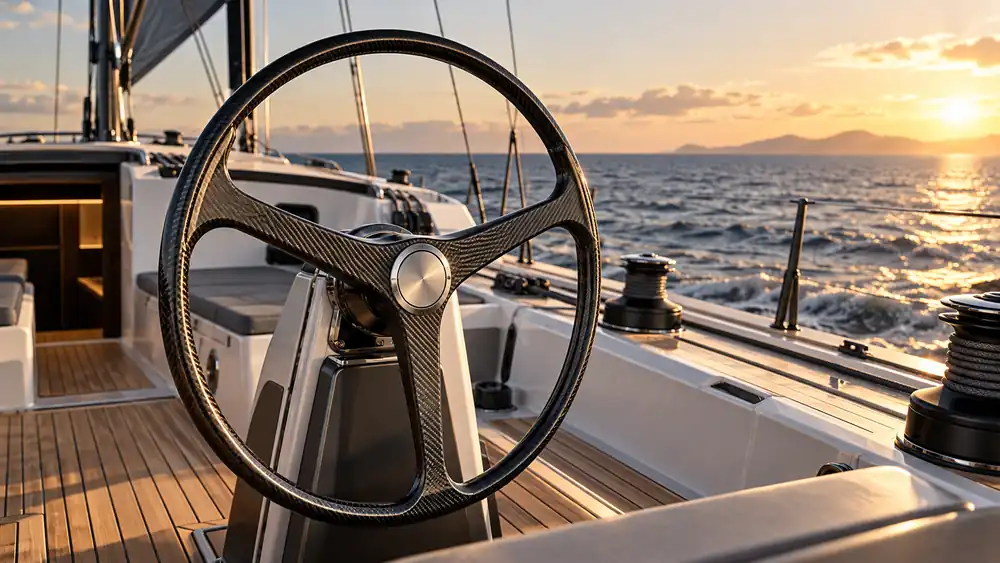
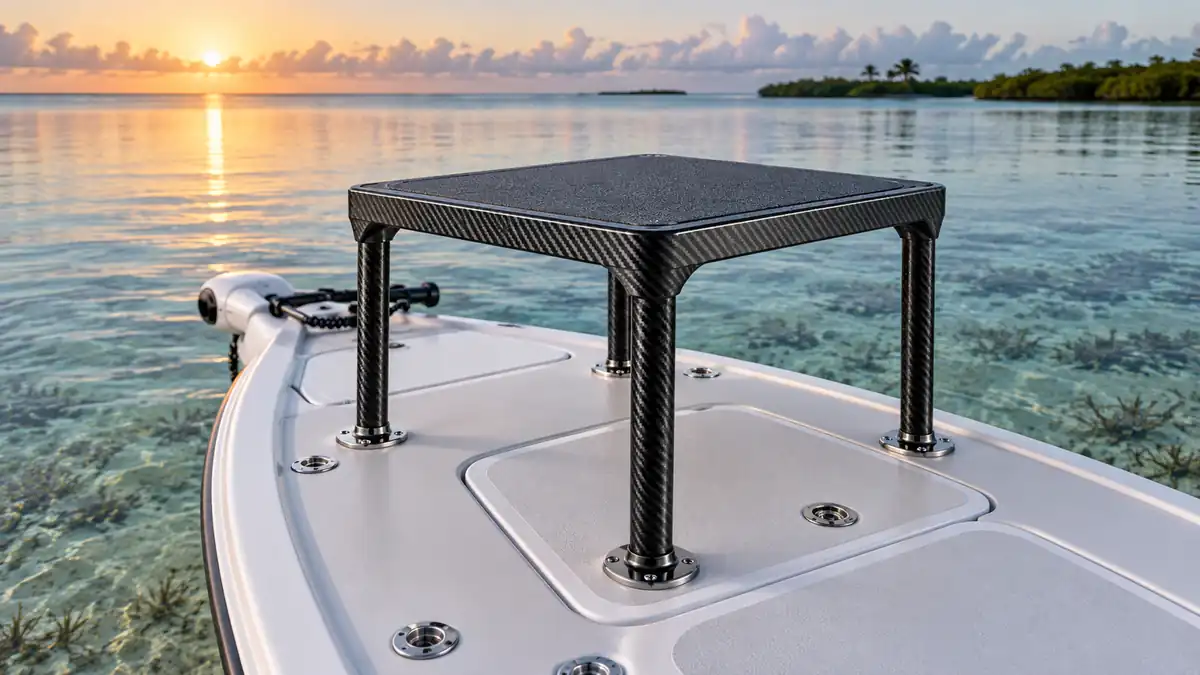
A Carbon fiber Casting Platform gives an angler a higher sight line without adding the mass of a conventional metal structure at the bow. For flats boats, technical skiffs and premium fishing boats, however, low weight is only one part of a successful design. Platform height, footprint, edge stiffness, non-slip performance, deck reinforcement and removable hardware all have to work as one system.
This guide explains how boat builders and marine brands can specify a custom platform, compare structural options and plan an OEM program. Noah Composites can provide OEM and ODM carbon fiber casting platform manufacturing, from design-for-manufacture and tooling through prototypes, surface finishing, hardware integration and repeat production.
Quick answer: the best platform is not simply the lightest one. It is the lightest structure that meets the boat-specific stiffness, load, stability, mounting, slip-resistance and durability requirements with an agreed verification plan.
Carbon Fiber Casting Platform at a Glance
| Design item | What must be defined | Why it matters |
|---|---|---|
| Boat and location | Hull model, bow-deck geometry, hatch clearance and available reinforcement | Controls footprint, mounting points and local deck loads |
| Casting Platform geometry | Usable standing area, overall height, leg spacing, edge radius and clearance | Balances visibility, ergonomics and stability |
| Design loads | User mass range, centered and edge loads, dynamic factor and transport condition | Drives laminate, core, joints and proof-test level |
| Deck surface | Non-slip pad or texture, drainage, barefoot comfort and replacement method | Reduces slip risk in wet, salty conditions |
| Mounting | Fixed or removable legs, socket geometry, backing plates and fastener material | Determines fit, serviceability and load transfer into the boat |
| Finish | Exposed weave or painted surface, UV protection, gloss and color | Protects the resin system and aligns with the boat brand |
| Validation | Dimensional inspection, static/proof load, joint checks and environmental requirements | Converts a visual concept into a controlled product |
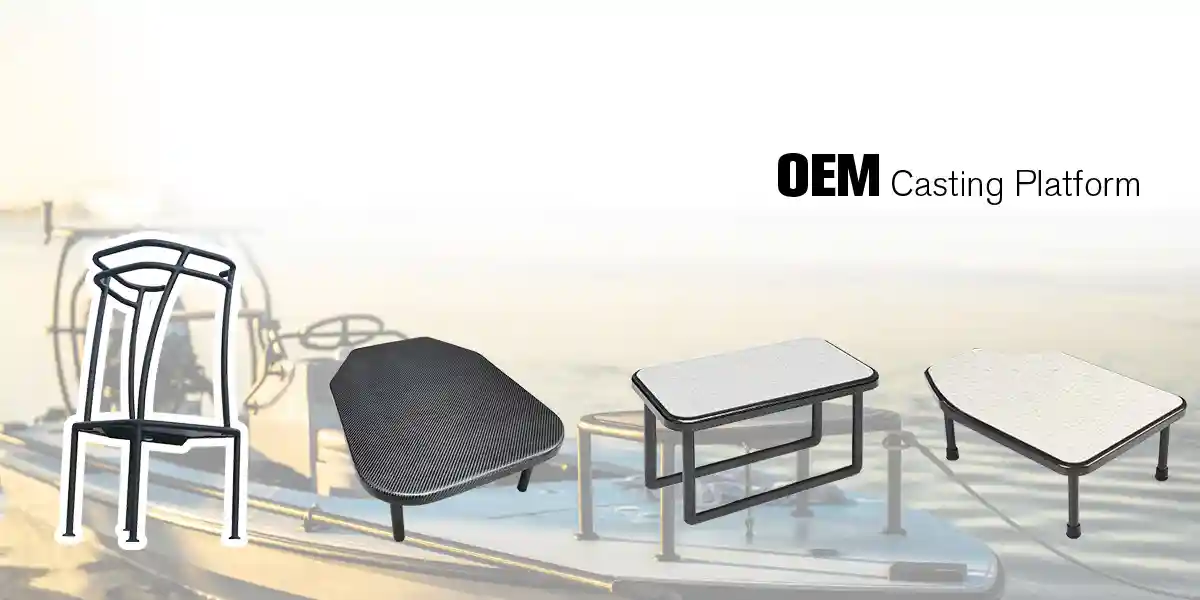
Commercial products demonstrate that compact square decks, removable legs and cushioned pads are practical configurations. Those examples are useful references, not universal specifications. A production design should start with the actual boat, intended users and target market.
What Is a Carbon Fiber Casting Platform?
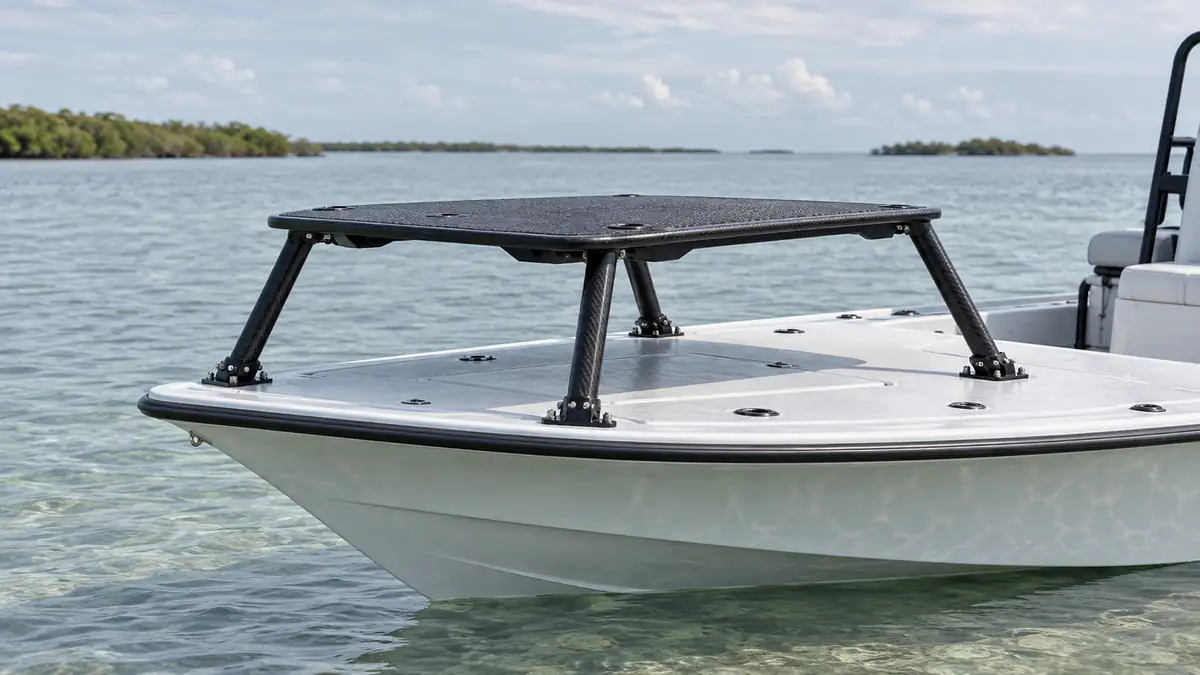
A casting platform is an elevated standing deck, usually installed near the bow, that improves the angler’s viewing angle when locating fish, structure and changes in water color. It is especially useful for sight fishing on shallow flats. A typical assembly contains a top panel, three or four supporting legs, joints or brackets, deck sockets or feet, fasteners and a non-slip walking surface.
In a well-designed Carbon fiber Casting Platform, the top may be a carbon-fiber sandwich panel, while the legs are carbon tubes or molded sections. The structure can be fixed, fully removable or designed with legs that detach from the top. Its real value is system-level mass reduction: removing weight high on the bow can be more useful than saving the same mass low in the hull.
Why Use Carbon Fiber Instead of Aluminum or Fiberglass?
The Casting Platform Material selection should follow the performance target, production volume and price position. Carbon fiber is attractive when premium appearance, low mass and high stiffness are important. Aluminum remains economical and repairable, while fiberglass may be suitable for cost-sensitive molded parts. The following comparison is directional; final performance depends on geometry, laminate and workmanship.
| Criterion | Carbon-fiber composite | Marine aluminum | Fiberglass composite |
|---|---|---|---|
| Specific stiffness | Excellent when fiber orientation follows load paths | Good, but often needs more section mass | Moderate; typically heavier for similar stiffness |
| Corrosion behavior | Does not rust, but conductive carbon must be isolated from dissimilar metals | Needs suitable alloy, coating and galvanic management | Good, subject to resin and water-ingress control |
| Surface appearance | Premium exposed-weave or painted finish | Painted, anodized or powder-coated | Gelcoat or paint |
| Tooling and labor | Higher process control and skilled bonding required | Efficient fabrication for simple welded frames | Good for molded production at moderate cost |
| Best fit | Premium boats, performance upgrades and OEM differentiation | Robust cost-controlled platforms | Integrated shapes where minimum mass is less critical |
Carbon fiber is not automatically superior in every detail. Poor joint design, an unsealed core or direct carbon-to-aluminum contact can undermine an otherwise excellent laminate. Understanding the carbon fiber material system is therefore as important as selecting the fiber.
Start With the Boat: Height, Footprint and Stability
Choose visibility without ignoring the center of gravity
A taller Casting Platform can improve the sight line, but it also raises the standing person and increases overturning moment. The effect depends on hull form, displacement, loading condition, platform location and how the angler moves. The platform supplier, boat builder and naval architect should therefore agree on the allowable height and footprint rather than copying a catalog dimension.
The ISO 12217 series addresses stability and buoyancy assessment for small craft, including load placement and offset-load evaluation. It does not provide a shortcut for accessory design, but it is a useful reminder that mass location matters. Review the appropriate current part for the specific craft, such as ISO 12217-1:2022 for relevant non-sailing boats of at least 6 m or ISO 12217-3:2022 for boats under 6 m.
Use the deck layout as a hard constraint
Map hatches, cleats, trolling-motor travel, anchor access, wiring routes, drainage paths and the angler’s casting arc. Place legs far enough apart to resist edge loading, but do not block normal deck use. Rounded corners reduce snagging, while a thin perimeter lip can help the user sense the deck boundary without creating a trip point.
For a retrofit, never assume that a visible deck skin can carry concentrated leg loads. Confirm the laminate, core condition, backing access and allowable drilling locations with the boat manufacturer or a qualified marine professional.
Engineer the Load Cases, Not Just a Weight Rating
A single “maximum load” number rarely describes real service. The engineering brief for a Carbon fiber Casting Platform should distinguish at least:
- a person standing near the center;
- a person stepping or leaning near an edge or corner;
- dynamic loads from boat motion, boarding or an abrupt weight shift;
- torsion caused by uneven support or deck tolerances;
- loads during removal, storage and road transport; and
- accessory loads if rails, holders or other equipment are attached.
Stiffness matters alongside strength. A top panel can survive a load yet feel unstable if it deflects excessively. A useful specification therefore defines allowable deflection, permanent set, joint movement and visual damage criteria in addition to the proof load. The safety factor and test load must be selected by the responsible engineer for the intended boat and market.
Casting Platform Top: Sandwich Construction and Non-Slip Surface
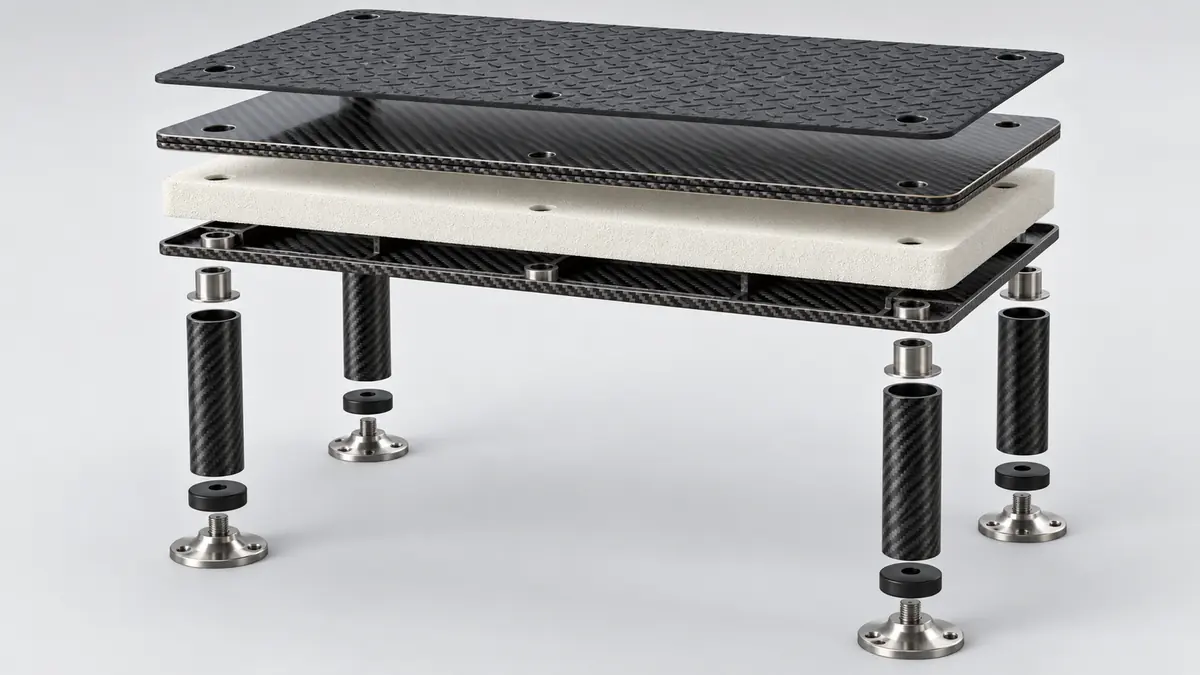
A lightweight top is commonly achieved with carbon skins around a structural foam or honeycomb core. The skins carry in-plane tension and compression, while the core separates them and carries shear. Local hard points are needed where legs, fasteners or accessories introduce concentrated loads. Simply drilling through a lightweight core and tightening a bolt can crush the core and create a water path.
Fiber orientation and local reinforcement should follow the actual span and load paths. Quasi-isotropic stacking may support multi-directional loads, while targeted 0° fibers can stiffen the main spans and ±45° plies can support shear and torsion. Edge close-outs must protect the core and withstand repeated handling.
Non-slip performance is a primary requirement
A glossy carbon surface is not an acceptable walking finish when wet. Specify a marine-grade traction pad or durable molded texture, including its wet-condition performance, drainage gaps, adhesive system and replacement procedure. The surface should provide grip without being abrasive to bare feet. Water must not collect around inserts or under a poorly sealed pad.
Legs, Joints and Marine Hardware
The legs transfer bending, shear and torsion between the top and the boat. Straight tubes are efficient, but raked legs may widen the support base. Connections can use bonded composite sockets, co-cured brackets, mechanically retained inserts or hybrid joints. The design should avoid abrupt stiffness changes and provide enough bonded area to prevent peel-dominated failure.
Carbon fiber Casting Platform is electrically conductive. Direct contact with aluminum in saltwater can accelerate galvanic corrosion of the metal. Use compatible stainless or titanium hardware where appropriate, protective coatings, nonconductive sleeves or washers, sealants and isolation layers. The exact isolation stack should be documented in the assembly drawing rather than left to the installer.
Fixed versus removable mounting
A fixed Casting Platform minimizes loose parts. A removable system can restore an open bow deck, simplify transport and make inspection easier. Removable sockets need controlled clearances so they do not rattle, bind with salt deposits or trap water. Captive pins and tool-light removal may improve usability, but every retention method must remain secure under the defined boat-motion loads.
Marine Durability and Maintenance
The carbon fiber Casting Platform itself tolerates seawater well, but the complete system includes resin, clear coat or paint, adhesives, core, inserts, pads and metal hardware. Specify UV-resistant finishing, sealed edges, drainage and repair criteria. Rinse salt and sand with fresh water, use cleaners approved for the finish and avoid harsh abrasives.
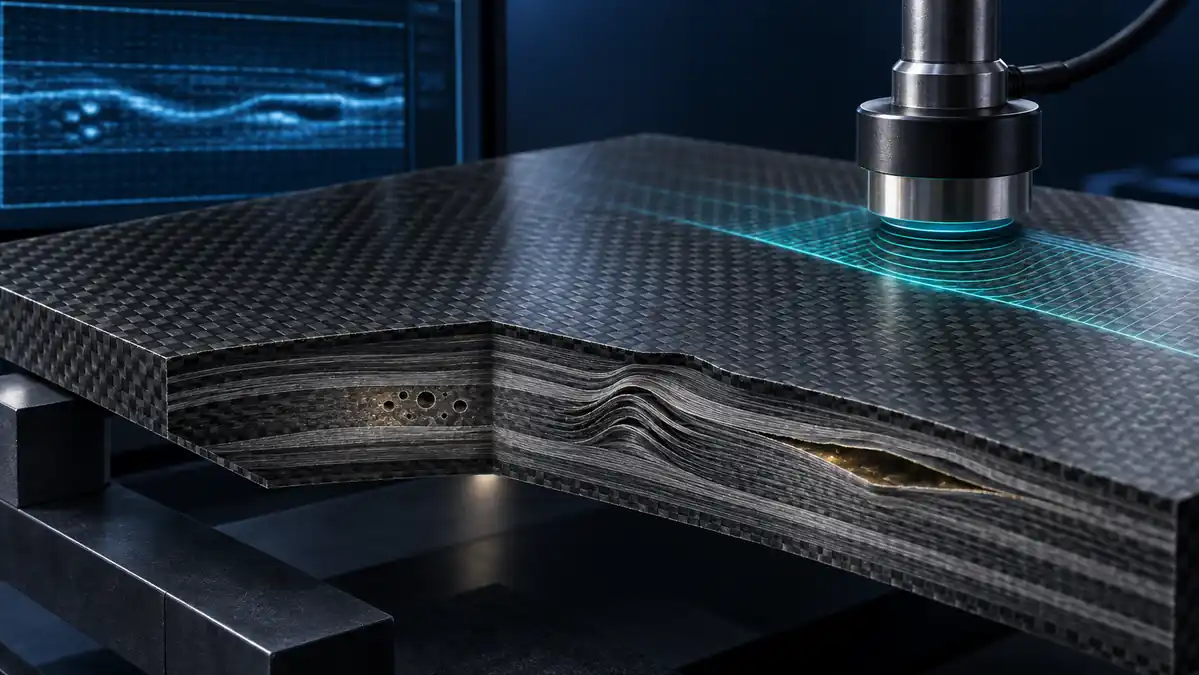
Before each season—and after an overload or impact—inspect for loose mounts, joint movement, cracked coating, white stress marks, soft areas, core exposure, corrosion staining and lifting pad edges. Remove the platform from service if damage could affect the load path. For broader manufacturing defect guidance, see carbon fiber defects and quality control.
How an OEM Carbon Fiber Casting Platform Is Manufactured
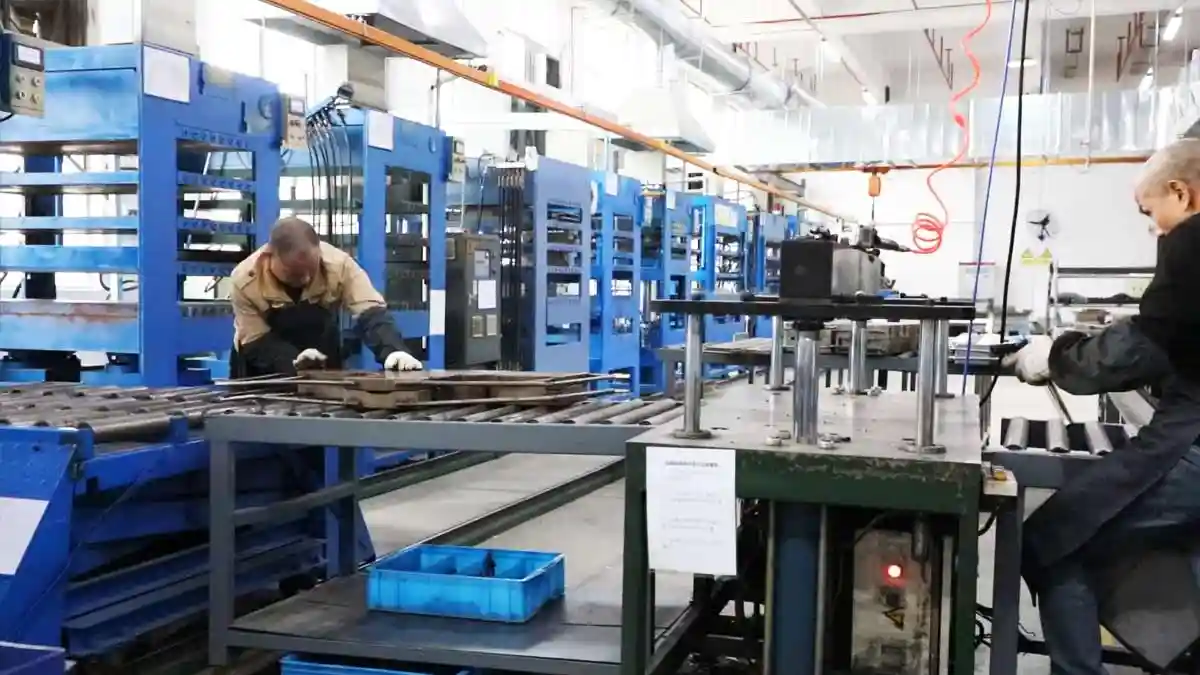
The manufacturing route depends on annual volume, geometry, finish and tolerances. Prepreg with oven or autoclave processing can provide tightly controlled laminates and premium exposed surfaces. Vacuum-bagged wet layup or infusion may fit larger parts and different cost targets. Compression molding can suit repeatable components at higher volumes. Tubes may be roll-wrapped or molded separately and bonded in controlled fixtures.
- Design input: collect 3D deck data, mounting envelope, target mass, use cases, loads, finishes and regulatory market.
- Engineering and DFM: define laminate, core, hard points, joint geometry, tolerances and assembly sequence.
- Tooling: build molds and bonding fixtures that control visible surfaces and mounting geometry.
- Prototype: manufacture a first article and check boat fit before locking production details.
- Validation: complete dimensional, stiffness, load, joint and environmental tests agreed in the specification.
- Production control: maintain material traceability, cure records, bonding preparation and inspection checkpoints.
Accurate trimming and hole location may use carbon fiber CNC machining, with dust control and sealed cut edges. A cosmetic clear weave also needs ply placement and tool-surface standards that are defined before production.
Noah Composites OEM and ODM Capability
Noah Composites can OEM a Carbon fiber Casting Platform for boat builders, marine equipment brands, distributors and product developers. Support can begin with customer drawings or with a performance brief that Noah’s engineering team develops into a manufacturable concept.
Project scope may include CAD review, laminate and joint DFM, molds and bonding fixtures, prototype builds, carbon tubes, sandwich panels, hardware integration, non-slip pad preparation, custom finish, inspection documentation, packaging and serial production. Explore Noah’s wider custom carbon fiber marine products or its custom composite product service.
The OEM agreement should identify who owns the boat-level stability assessment, installation instructions, applicable market requirements and final product approval. For products sold in the United States, the U.S. Coast Guard manufacturer resources provide regulatory and safety information for boat and associated-equipment manufacturers. ABYC also develops and annually reviews small-craft standards. Applicability should be determined for the actual product and market.
Quality Control and Validation Plan
A production drawing and inspection plan should turn subjective expectations into measurable acceptance criteria. Depending on the program, checks may include:
- overall dimensions, leg-to-leg spacing, mount flatness and boat-fit gauge;
- finished mass and balance;
- surface weave, gloss, pinholes, scratches and pad adhesion;
- cure records, laminate or process traveler and material traceability;
- bond-line preparation, gap and adhesive cure;
- insert torque or retention checks;
- static and proof loading at center, edge and specified corners;
- deflection under load and residual set after unloading; and
- saltwater, UV, thermal cycling or fatigue testing when required by the use case.
Testing one attractive Casting Platform prototype is not enough. The plan must also define how routine production remains equivalent—through controlled materials, documented cure cycles, calibrated fixtures and repeatable inspection.
RFQ Checklist for a Custom Casting Platform
To receive a meaningful quotation, provide:
- boat make/model, deck drawing, 3D scan or accurate mounting coordinates;
- target standing area and platform height range;
- fixed, removable-leg or fully removable configuration;
- user/load cases and the party responsible for structural approval;
- deck construction, backing access and permitted fastener locations;
- finish, weave direction, color, gloss and non-slip pad preference;
- hardware material, isolation and corrosion expectations;
- target mass, annual quantity and launch schedule;
- required tests, inspection reports, packaging and labeling; and
- sales markets and applicable compliance requirements.
If some inputs are unknown, Noah Composites can review the concept and identify the data needed before tooling. Early collaboration usually reduces late changes at the deck interface—the area where platform and boat responsibilities meet.
Frequently Asked Questions
Can Noah Composites OEM this product?
Yes. Noah Composites can provide OEM and ODM support for a custom carbon fiber casting platform, including DFM, tooling, prototypes, structural components, bonding, surface finishing, hardware integration, inspection and production. Final scope depends on the customer’s design maturity and validation requirements.
What size and height should the platform be?
There is no universal size. The standing area must suit the user, while the height, footprint and leg spacing must suit the boat’s deck layout and stability. Boat-builder or naval-architecture review is particularly important when the platform raises a person above the original deck.
How much does a carbon platform weigh?
Weight depends on dimensions, design loads, panel core, leg geometry, hardware and finish. Ask suppliers to quote mass against an agreed structural requirement; a lighter number without comparable stiffness and validation is not a reliable comparison.
Can the legs be removable?
Yes. Removable legs or a fully removable assembly can be designed with sockets and captive retention. The interface needs corrosion isolation, drainage, controlled fit and a documented inspection method.
Does exposed carbon fiber need protection?
Yes. The resin and cosmetic surface should receive a suitable UV-resistant clear coat or marine finish. Cut edges, inserts and core transitions must also be sealed against water ingress.
Is a carbon fiber platform automatically safe for any boat?
No. Adding an elevated standing position changes load placement and may affect stability. The platform, deck reinforcement, attachment method and boat-level effects must be reviewed for the specific vessel, use and applicable requirements.
Build a Boat-Specific Platform, Not a Generic Accessory
The best Carbon fiber Casting Platform combines low mass with predictable stiffness, wet grip, durable joints and a verified connection to the boat. Treating the top, legs, hardware and deck as one load path is what separates a premium-looking accessory from a reliable marine product.
For a new OEM program, prepare the boat geometry, target use, load cases, finish and production volume. Then contact Noah Composites to discuss engineering inputs, prototype timing and a scalable manufacturing plan.