Carbon Fiber Autoclave Manufacturing for High-Performance Composites
Our autoclave manufacturing capability represents a core pillar within our integrated carbon fiber production system. It is engineered to deliver high-performance composite components with precise structural control, consistent quality, and reliable production repeatability.
By combining controlled temperature and pressure curing with a fully in-house manufacturing chain, we ensure that every stage of the composite process—from material preparation to final finishing—is fully managed under strict engineering standards. This enables us to support demanding applications across automotive, marine, aerospace, and industrial sectors where both mechanical performance and surface quality are critical.
Rather than operating as an isolated process, the autoclave curing is deeply integrated into our overall carbon fiber manufacturing ecosystem, ensuring full traceability, stable process control, and scalable production capability.
Autoclave Manufacturing in Composite Engineering
Autoclave manufacturing is a high-precision composite production process widely used in advanced carbon fiber engineering applications. It plays a critical role in the production of structural components requiring high mechanical strength, low void content, and excellent surface finish quality.
In modern composite manufacturing systems, autoclaving is considered one of the most reliable processes for producing aerospace-grade and industrial-grade carbon fiber components. The process combines controlled temperature, pressure, and vacuum environments to ensure optimal resin flow, fiber consolidation, and structural integrity.
Compared with traditional molding techniques, autoclave-based systems offer significantly improved performance in terms of dimensional accuracy, fatigue resistance, and material consistency. As a result, it is widely adopted in aerospace, automotive, marine, and industrial sectors.
Our company operates a fully integrated autoclave curing system as part of a complete carbon fiber production chain, ensuring full in-house control from raw material preparation to final composite finishing.
Autoclave Manufacturing as a Core Carbon Fiber Production Technology

Role of Autoclave Manufacturing in Carbon Fiber Production
Autoclave curing is a core process in carbon fiber composite production systems. It is particularly important in applications where structural reliability and surface precision are critical. In carbon fiber autoclave manufacturing, prepreg materials are cured under controlled pressure and temperature conditions, allowing the resin system to fully crosslink while maintaining fiber alignment. This results in high-performance composite structures with minimal defects.

Carbon Fiber Autoclave Manufacturing Characteristics
Carbon fiber autoclave curing is distinguished by its ability to produce complex structural parts with high mechanical consistency. The process ensures uniform heat transfer and pressure distribution, which significantly reduces internal voids and enhances bonding between fiber layers.
Key characteristics include:
High fiber volume fraction control
Excellent surface finish quality
Reduced porosity and void content
Superior mechanical stability under load

Composite Autoclave Manufacturing Advantages
Composite autoclave manufacturing provides superior performance compared to non-autoclave processes such as compression molding or open curing systems.
Advantages include:
Improved structural integrity
Enhanced fatigue resistance
Greater dimensional stability
Higher reliability in critical applications
This makes composite autoclave molding particularly suitable for aerospace-grade and high-performance automotive components.
Our Fully In-House Autoclave Manufacturing System
Integrated Manufacturing Chain Overview
Our manufacturing system is part of a fully integrated carbon fiber production ecosystem. All processes are controlled internally, ensuring consistency, traceability, and engineering precision across all production stages.
The system includes:
Carbon fiber fabric preparation
Prepreg material handling and cold storage
CNC cutting and layup processing
Vacuum bagging and pre-curing stabilization
Autoclave curing process
Trimming and finishing operations
Surface coating in controlled clean environments
Carbon Fiber Manufacturing Integration
It is not an isolated process but a critical stage within our broader carbon fiber manufacturing system. This integration ensures full control over fiber architecture, resin system behavior, and final structural performance.
By maintaining an in-house system, we eliminate reliance on external suppliers and ensure consistent quality across all production batches.
Quality Control and Process Stability
Process stability is a key advantage. Each production cycle is monitored through controlled thermal and pressure profiles, ensuring repeatable and predictable results.
Key quality control parameters include:
Temperature uniformity
Pressure consistency
Vacuum integrity
Cure cycle optimization
Autoclave Curing Process and Engineering Principles
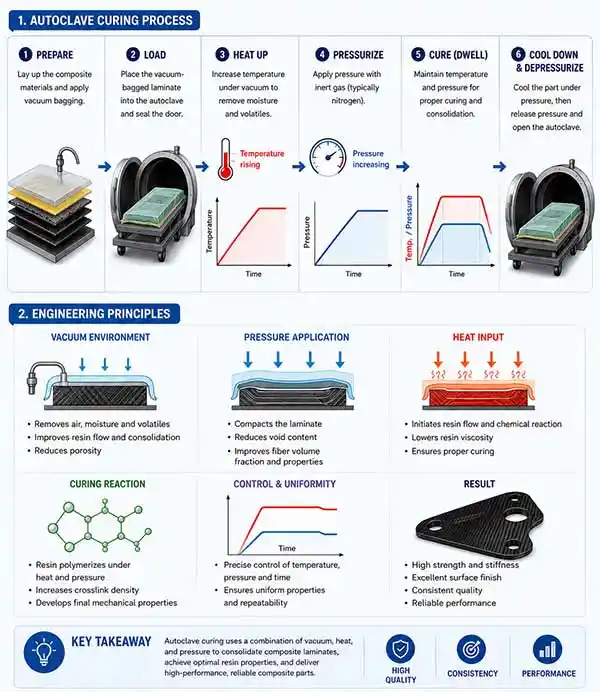
1. Autoclave Curing Process Overview
The process is a controlled thermal-mechanical method used to consolidate composite materials under elevated temperature and pressure conditions.
During autoclave curing, resin systems undergo polymerization while pressure is applied to eliminate voids and improve fiber-resin bonding.
2. Process Control Parameters
Autoclave curing performance is highly dependent on precise control of processing parameters. These include: Heating rate control Peak temperature stabilization Pressure regulation Cooling cycle management Vacuum maintenance
3. Structural Performance Enhancement
The autoclave curing process significantly improves the structural performance of carbon fiber composites. Key improvements include: Increased tensile strength Improved fatigue resistance Enhanced impact durability Superior long-term stability
Single-Side Mold Capability in Autoclave Manufacturing
Manufacturing Principle
Our autoclave curing system is optimized for single-side mold structures. This allows the production of complex composite geometries with high surface accuracy on one side while maintaining structural integrity throughout the component.
Engineering Application Scope
Single-side mold is suitable for:
Large-scale structural panels
Complex aerodynamic components
Lightweight structural assemblies
High-performance exterior parts
Design Flexibility
This manufacturing approach provides high flexibility in component design while maintaining strict control over dimensional accuracy and structural performance.
Applications of Autoclave Manufacturing Technology

Automotive Industry Applications
Autoclave manufacturing is widely used in automotive engineering where weight reduction and performance optimization are critical. Applications include: Carbon fiber exterior body panels Aerodynamic kits and performance components Interior structural trim systems Lightweight reinforcement structures

Marine and Water Sports Applications
Autoclave carbon fiber manufacturing is extensively used in marine environments due to its corrosion resistance and mechanical stability.
Applications include:
Yacht masts and structural spars
Racing sailboat hull structures
Jetboard and surfboard shells
Marine composite housings

Aerospace and Rail Transit Applications
Autoclave curing is widely used in aerospace engineering due to its ability to produce lightweight and high-strength structural components. Applications include: Aircraft interior panels Structural composite assemblies Lightweight load-bearing components

Industrial and Defense Applications
Autoclave curing is also applied in industrial and defense sectors requiring high-performance composite structures.
Applications include:
UAV structural systems
Industrial equipment housings
Military-grade composite shells
Technical Advantages of Autoclave Manufacturing
Mechanical Performance Advantages
Autoclave curing significantly enhances the mechanical properties of carbon fiber composites.
Key benefits include:
High strength-to-weight ratio
Superior fatigue resistance
Improved impact resistance
Long-term structural reliability
Surface Quality and Precision
The autoclave process ensures high-quality surface finishes and dimensional accuracy suitable for visible structural components.
Process Repeatability
Controlled autoclave environments ensure consistent manufacturing results across multiple production cycles, making it suitable for industrial-scale applications.
Equipment Specifications and Process Control
Industrial Autoclave System Specifications
Our autoclave manufacturing system is equipped with two industrial-grade curing units designed for high-performance carbon fiber composite production. Both systems support controlled temperature, pressure, and vacuum environments to ensure stable and repeatable composite curing cycles.

XD200 Autoclave System (Φ1.5m × L3.0m)
The XD200 autoclave system is designed for medium-sized composite components requiring high precision and stable curing performance.
Technical Specifications
- Chamber size: Φ1.5m × L3.0m
- Maximum design temperature: 200°C
- Long-term stable operating range: Ambient temperature to 180°C
- Maximum design pressure: 1.0 MPa
- Standard safe operating pressure: ≤0.8 MPa
- Vacuum capability: -0.095 MPa (industry-standard level)

XD300 Autoclave System (Φ2.5m × L5.0m)
The XD300 autoclave system is our large-scale production unit designed for oversized structural components and high-volume industrial composite manufacturing.
Technical Specifications
- Chamber size: Φ2.5m × L5.0m
- Maximum design temperature: 200°C
- Long-term stable operating range: Ambient temperature to 180°C
- Maximum design pressure: 1.6 MPa
- Standard safe operating pressure: ≤1.2 MPa
- Vacuum capability: -0.095 MPa
Process Control and Manufacturing Stability
Beyond equipment specifications, the performance of autoclave manufacturing is determined by process control precision and production stability. Our system is engineered to ensure consistent thermal distribution, pressure uniformity, and vacuum integrity throughout the entire curing cycle.
Each production batch follows a strictly controlled curing profile, including temperature ramp-up, dwell time stabilization, pressure balancing, and controlled cooling stages. This ensures repeatable composite quality across different part geometries and production volumes.
The integration of vacuum bagging and autoclave pressure systems significantly reduces internal voids and improves fiber-resin bonding, resulting in high structural reliability and long-term durability of carbon fiber components.
This level of process control is essential for high-performance applications in automotive, aerospace, marine, and industrial composite manufacturing.
Engineering Support and Manufacturing Services
Custom Composite Manufacturing Solutions
We provide engineering support for custom carbon fiber composite development, including prototype validation and production feasibility analysis.
CAD-Based Evaluation Services
Clients can submit CAD Designs for manufacturability assessment and process optimization recommendations.
FAQ
It is a controlled composite curing process that applies heat, pressure, and vacuum to consolidate prepreg carbon fiber materials. It is widely used in high-performance industries such as aerospace, automotive, marine, and industrial engineering.
In carbon fiber manufacturing, this process ensures low void content, high structural integrity, and superior surface quality compared to non-autoclave processes.
Autoclave curing uses controlled temperature and pressure in a sealed environment, typically with prepreg materials, while compression molding relies on mechanical pressing of resin-based materials in molds.
Autoclave systems generally provide higher structural performance, lower porosity, and better surface finish, making them suitable for aerospace-grade composite applications.
Carbon fiber autoclave molding is used for producing high-strength, lightweight composite components that require precise structural performance.
Typical applications include automotive body panels, aerospace structures, marine components, and industrial equipment housings.
Composite autoclave manufacturing is widely used in:
- Automotive industry (exterior and structural components)
- Aerospace and aviation (interior and structural panels)
- Marine industry (masts, hulls, and structural parts)
- Industrial engineering (equipment housings and structural systems)
The autoclave curing process ensures controlled polymerization of resin systems under heat and pressure. This results in improved fiber-resin bonding, reduced void content, and enhanced mechanical performance.
It is considered one of the most reliable processes for high-performance carbon fiber manufacturing.
Yes. Our autoclave molding system is optimized for single-side mold structures, enabling the production of complex geometries with high surface precision and structural stability.
This allows manufacturing of automotive aerodynamic parts, marine structures, and aerospace-grade components.
Yes. Our manufacturing system is fully in-house, covering carbon fiber fabric processing, prepreg handling, CNC cutting, vacuum bagging, autoclave curing, finishing, and surface coating.
No outsourcing is involved in any stage of production.
Our autoclave system is designed for industrial-scale composite manufacturing, capable of producing large structural components with controlled temperature and pressure cycles.
Exact specifications depend on project requirements and component design.
Yes. We support CAD-based engineering evaluation to assess manufacturability, structural feasibility, and production optimization for autoclave composite manufacturing projects.
Autoclave manufacturing is a high-precision subset of composite manufacturing that uses controlled pressure and temperature environments. It provides significantly higher structural performance, lower defects, and better surface quality compared to general composite molding methods.