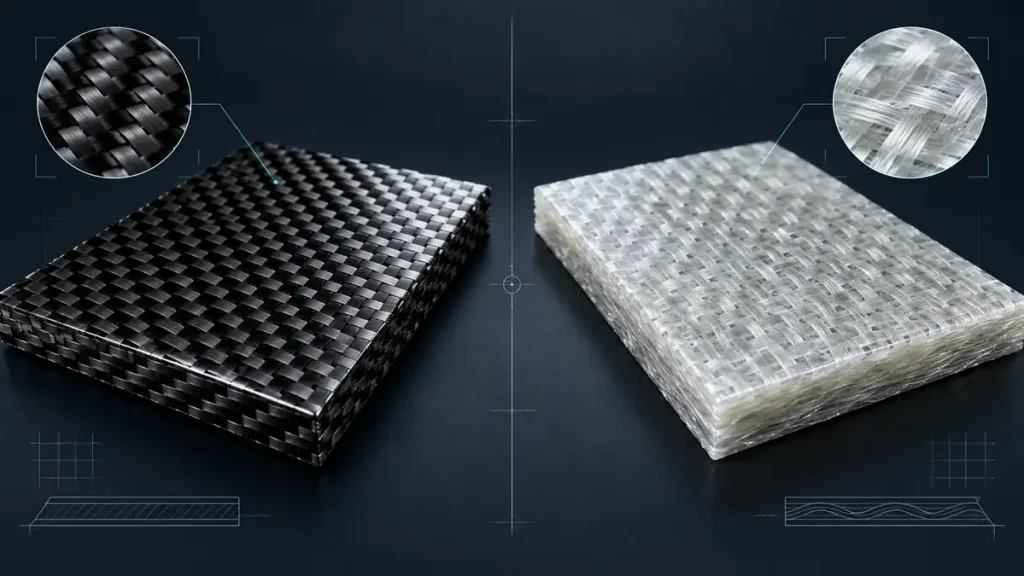
Carbon fiber is usually the better choice when stiffness and weight are hard design limits; fiberglass is usually better when impact tolerance, electrical insulation, and cost matter more. Neither material is universally stronger or more economical. The correct decision depends on the finished laminate—not the fiber alone—and on load direction, resin, fiber volume, manufacturing process, geometry, production quantity, and acceptance tests.
This guide gives engineers, product developers, and sourcing teams a practical framework for choosing between carbon-fiber-reinforced polymer (CFRP) and glass-fiber-reinforced polymer (GFRP) for a custom part.
Carbon Fiber vs Fiberglass: Quick Comparison
| Decision factor | Carbon fiber composite | Fiberglass composite | Typical advantage |
|---|---|---|---|
| Density | Lower | Higher | Carbon fiber |
| Stiffness at equal weight | Very high | Moderate | Carbon fiber |
| Tensile strength | High, strongly grade- and layup-dependent | Good, strongly grade- and layup-dependent | Application-dependent |
| Strain before failure | Generally lower | Generally higher | Fiberglass |
| Impact and damage tolerance | Can be sensitive to impact and hidden delamination | Often more forgiving | Fiberglass |
| Electrical behavior | Conductive | Insulating | Depends on requirement |
| Thermal expansion | Very low along the fiber direction | Higher | Carbon fiber for dimensional stability |
| Raw material cost | Higher | Lower | Fiberglass |
| Cosmetic appearance | Distinctive woven-carbon appearance | Usually painted or gel-coated | Carbon fiber for exposed weave |
| Radio-frequency transparency | Poorer because it is conductive | Usually better | Fiberglass |
Important: this table describes general tendencies. A thin woven carbon skin, a thick chopped-glass molding, and a unidirectional structural laminate are not equivalent products. Use supplier laminate data and representative-part testing before approving a safety-critical design.
What Are CFRP and GFRP?
Carbon fiber and glass fiber are reinforcements. They become useful structural materials after they are combined with a polymer resin and cured. The reinforcement carries much of the directional load; the resin transfers load between fibers, holds the shape, protects the fibers, and influences temperature, chemical resistance, toughness, and processing.
CFRP uses carbon reinforcement. GFRP uses glass reinforcement, commonly E-glass and, for higher performance, S-glass. Either may use epoxy, vinyl ester, polyester, or a thermoplastic matrix. The final properties also depend on whether the reinforcement is unidirectional, woven, braided, chopped, or formed as a preform.
That distinction matters. For example, Toray lists T700S carbon fiber at 230 GPa tensile modulus and 1.80 g/cm³ density, while its normalized unidirectional epoxy composite data show a different, lower laminate modulus. The Toray T700S data sheet is a useful reminder that fiber data and cured-composite data are not interchangeable. See our guides to carbon fiber material, carbon fiber modulus, and T700 carbon fiber for more detail.

Is Carbon Fiber Stronger Than Fiberglass?
The honest answer is: under which load, in which direction, and for what mass or thickness?
Tensile strength is only one part of the decision
A well-designed carbon/epoxy laminate can achieve excellent tensile performance, but some high-grade glass reinforcements also have strong tensile properties. The apparent winner can change when you compare bare fibers, unidirectional coupons, quasi-isotropic panels, or finished molded parts.
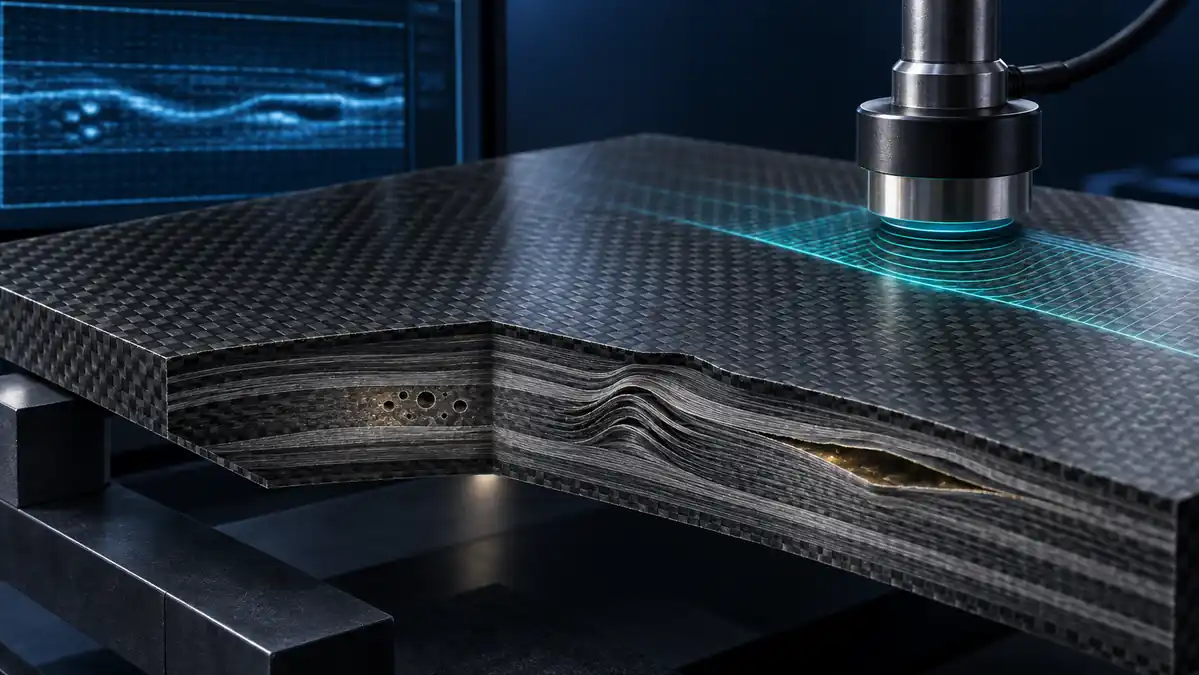
For a real component, premature failure may come from compression, buckling, interlaminar shear, a bonded joint, a fastener hole, a sharp radius, impact damage, or a manufacturing defect—not from simple tensile overload. A responsible specification therefore defines the load cases and failure modes before selecting a fiber.
Carbon fiber usually has the decisive stiffness advantage
Many lightweight structures are stiffness-controlled: they must not bend, twist, flutter, lose alignment, or allow a surface to deform. Carbon fiber’s high modulus makes it possible to meet a deflection target with less mass or a thinner section. That is why carbon is attractive for foil masts, paddles, robotic arms, precision structures, performance vehicle components, and sporting goods.
Fiberglass can reach the same stiffness in some designs by increasing laminate thickness or changing section geometry, but that usually adds weight. If the product can accept the extra thickness and mass, GFRP may still deliver the better business case.
Fiberglass can be more forgiving under impact
Glass fiber generally accommodates more strain before failure. In products that experience knocks, abrasion, rough handling, or uncertain overloads, a properly designed fiberglass laminate may offer useful toughness and visible, repairable damage. Carbon composites can be engineered for impact, but they require deliberate laminate design, toughened resins, protective outer plies, cores, or hybrid reinforcement.
Weight: Compare Finished Parts, Not Equal Fabric Area
Carbon fiber has a lower reinforcement density than typical glass fiber, but the meaningful comparison is the mass of two finished parts that meet the same requirements. Equal fabric area or equal laminate thickness does not guarantee equal stiffness, strength, resin content, or safety factor.
Use one of these comparison bases:
- Equal thickness: useful when packaging fixes the available space.
- Equal mass: useful when the product has a strict weight budget.
- Equal stiffness: often the most relevant basis for beams, masts, panels, and precision components.
- Equal validated performance: the best basis for procurement because it includes strength, deflection, impact, fatigue, environment, and safety factors.
System-level savings can justify carbon even when its material price is higher. A U.S. Department of Energy study reported a 25% blade-mass reduction when carbon-fiber spar caps replaced fiberglass in the evaluated wind-turbine designs. That result is application-specific, not a universal percentage, but it demonstrates why engineers should evaluate the complete structure. Read the DOE project summary.
Cost: Why Price per Kilogram Is Misleading
Fiberglass normally wins on reinforcement price, yet raw material is only one line in the cost model. A realistic comparison includes:
- engineering and laminate development;
- tooling and fixtures;
- fiber, resin, core, inserts, and consumables;
- cutting, layup, molding, curing, trimming, and finishing labor;
- cycle time, scrap rate, and expected annual quantity;
- inspection, destructive testing, and first-article validation;
- packaging, logistics, assembly, maintenance, and service life.
Carbon can create value when lower mass enables a smaller motor, higher payload, better acceleration, lower operator fatigue, or increased range. Fiberglass often creates value when weight is acceptable and the main goals are low tooling risk, corrosion resistance, electrical insulation, or economical large surfaces.
Ask suppliers for a finished-part quotation against the same acceptance criteria. Comparing a hand-laminated GFRP shell with an autoclave-cured CFRP part without normalizing quality, surface, tolerance, and performance does not support a sound decision.

Manufacturing Process Changes the Answer
The best reinforcement cannot compensate for the wrong manufacturing route. Noah Composites reviews material, geometry, production volume, surface class, tolerances, and validation together through its carbon fiber manufacturing workflow.
Prepreg and autoclave molding
Prepreg provides controlled resin content and precise ply placement. Autoclave manufacturing adds heat and pressure for consolidation. This route is valuable for high-performance CFRP parts with demanding laminate control and surface requirements, although material storage, labor, tooling, and cure time affect cost.
Compression molding
Carbon fiber compression molding can provide repeatable geometry, shorter cycles, and good production scalability. Continuous-fiber prepreg, sheet molding compounds, and chopped-fiber charge formats serve different structural and cosmetic goals. “Compression molded” alone does not define performance—the charge architecture and flow behavior matter.
Vacuum infusion and RTM
Vacuum infusion is frequently considered for larger shells and panels, including marine structures. Resin transfer molding uses a closed tool and can provide controlled surfaces and repeatable production when the geometry and quantity support the tooling investment. Both carbon and glass reinforcement can be used; permeability, resin flow, dry spots, and fiber wash must be controlled.
CNC trimming and secondary operations
Holes, bonded inserts, trimmed edges, and datum features can dominate fit and durability. Carbon is electrically conductive, so contact with aluminum in a wet environment may require isolation to reduce galvanic-corrosion risk. Fastener zones may need local reinforcement, load-spreading hardware, or bonded inserts.
Environmental and Functional Differences
Corrosion and moisture
Both CFRP and GFRP can resist many environments that corrode metals, but the resin system and protective finish determine much of the chemical, UV, and moisture performance. Marine parts require attention to water absorption, surface protection, joints, and impact—not simply a “corrosion-proof” label.
Electrical and RF behavior
Carbon fiber conducts electricity and can attenuate radio signals. Fiberglass is generally electrically insulating and is often preferred for radomes, antenna housings, electrical equipment, and structures where conductivity creates risk. Conductivity can be useful for grounding or heating, but it must be designed rather than assumed.
Temperature and dimensional stability
Carbon laminates can provide very low thermal expansion in selected directions. However, service temperature is often limited by the resin’s glass-transition temperature, cure state, moisture conditioning, and load duration. Specify continuous and peak temperatures, not just “high temperature.”
Appearance and finish
Exposed woven carbon provides a premium visual surface, but cosmetic weave does not prove structural quality. Define weave style, orientation, gloss level, pinhole allowance, clear coat, UV exposure, and acceptable visual variation. Fiberglass is typically painted or gel-coated and is well suited to color-matched or radio-transparent covers.

Which Material Fits Your Application?
Marine and water-sports parts
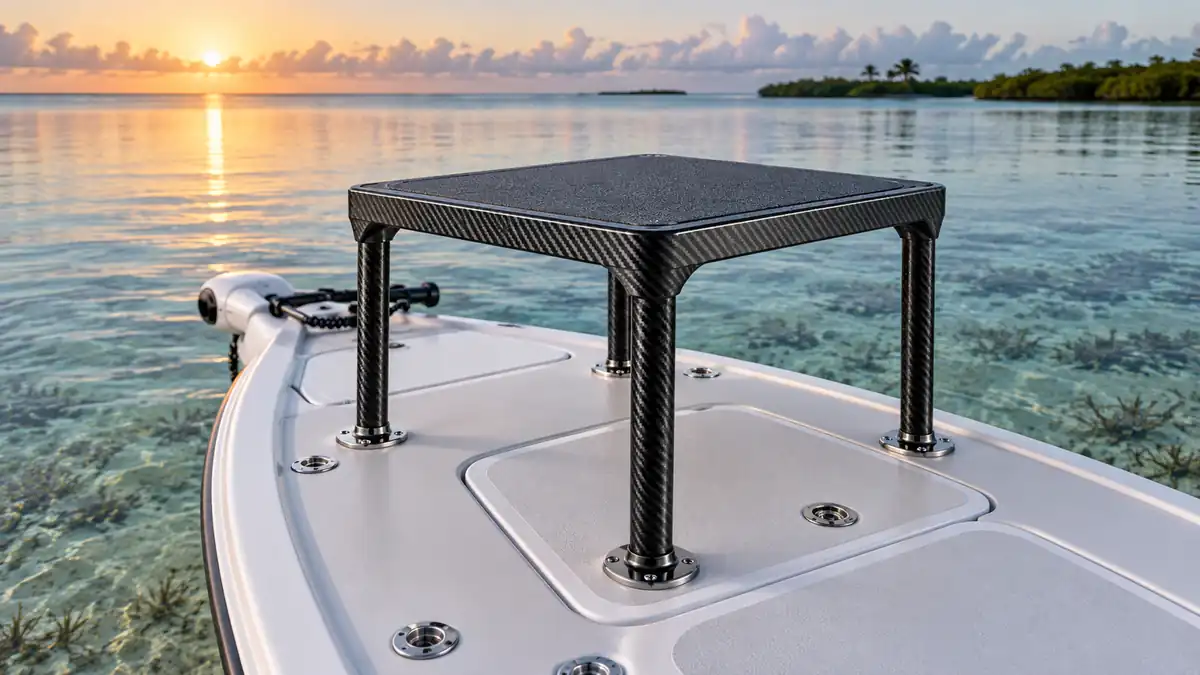
Choose carbon when mass and stiffness directly improve response, efficiency, or handling—for example, performance paddles, hydrofoil components, and selected yacht structures. Choose fiberglass for cost-sensitive hulls, covers, and impact-prone structures where added weight is acceptable. Hybrid construction can put carbon in stiffness-critical load paths and glass in protective or electrically isolating plies. Explore our marine products and water-sport equipment capabilities.
Automotive parts
Carbon is appropriate when weight reduction, stiffness, heat-stable geometry, or exposed appearance has measurable value. Fiberglass suits body panels, covers, and styling parts where price and impact tolerance lead. Structural, crash-related, or road-legal components require application-specific engineering and validation. See carbon fiber automotive parts.
Sports equipment
Carbon enables designers to tune stiffness, swing weight, and energy transfer in paddles, rackets, sticks, and other sports equipment. Glass layers may improve feel, strain capacity, and impact durability. The best layup often uses different fiber angles and, in some products, more than one reinforcement type.
Rescue, industrial, and electrical equipment
Low mass can reduce operator fatigue in stretchers, ladders, and deployable equipment. But conductivity, impact, fire performance, and inspection requirements can make fiberglass the safer selection for some electrical or rough-service environments. Define standards and use conditions before selecting CFRP solely for weight.
Can Carbon Fiber and Fiberglass Be Combined?
Yes. A hybrid laminate can place carbon where stiffness is needed and glass where cost, impact behavior, insulation, or surface protection matters. Examples include carbon caps with glass shear webs, glass outer plies over carbon, or local carbon reinforcement in a primarily GFRP structure.
Hybrid design is not simply stacking available fabrics. Carbon and glass have different stiffness and failure strains, so the carbon may attract load and fail before the glass is fully utilized. Ply order, interfaces, residual stress, impact response, and galvanic isolation require engineering review. Representative coupons and components should be tested.
A 7-Step Material Selection Framework
- Define the mission. State what the part does, who uses it, expected service life, and unacceptable failure modes.
- Quantify loads and deflection. Include static, dynamic, fatigue, impact, buckling, torsion, and joint loads.
- Define the environment. Record temperature, UV, water, chemicals, fire, electrical, and RF requirements.
- Set mass, envelope, and surface limits. Decide whether weight, thickness, finish, or stiffness is the governing constraint.
- Estimate volume and cost targets. Prototype quantity, annual demand, tooling budget, and expected design changes affect the process.
- Select material and process together. Review fiber form, resin, core, layup, molding route, trimming, inserts, and finish as one system.
- Validate before production. Agree on coupons, first articles, dimensional inspection, nondestructive evaluation, and application tests.
Testing and Quality: What to Put in the Specification
“Carbon fiber” or “fiberglass” is not a complete specification. Depending on risk, an acceptance plan may include fiber and resin traceability, cure records, mass or thickness, fiber volume, void content, dimensional inspection, surface criteria, tensile or flexural coupons, fatigue, impact, environmental conditioning, and proof-load testing.
ASTM composite standards cover tensile, compression, shear, fatigue, flexure, glass-transition temperature, moisture conditioning, and other properties. ASTM D3039/D3039M is widely used for in-plane tensile properties of polymer-matrix composites. The correct test matrix depends on the part and governing industry requirements.
Noah Composites uses a project-specific engineering and quality workflow; visit our research and development page for capability context. Any published typical value should be treated as a screening input, not a guaranteed property for your finished component.
RFQ Checklist for Carbon Fiber or Fiberglass Parts
Send the following information to reduce quotation time and avoid assumptions:
- 3D CAD file and controlled 2D drawing with revision;
- application, load cases, target stiffness, and safety factors;
- operating temperature, UV, moisture, chemicals, fire, electrical, and RF conditions;
- maximum part mass and dimensional envelope;
- mating components, inserts, fasteners, bond lines, and datum features;
- visible surfaces, weave orientation, color, gloss, and defect limits;
- prototype quantity, annual quantity, and ramp schedule;
- required standards, inspection reports, traceability, and validation tests;
- target cost and whether tooling should support future revisions.
For a drawing-based review, see our custom composite products capabilities or contact the Noah Composites engineering team.
Frequently Asked Questions
Is carbon fiber lighter than fiberglass?
The carbon reinforcement is generally less dense than glass reinforcement, and carbon’s high stiffness can allow a thinner or lighter structure. Compare complete parts designed to the same performance and safety requirements; the weight saving is not a universal percentage.
Is fiberglass cheaper than carbon fiber?
Usually at the raw-material level. Finished-part cost also includes tooling, labor, process yield, cure time, finishing, quality control, logistics, and lifecycle value. Request comparable quotations against the same specification.
Which is better for impact?
Fiberglass is often more forgiving because of its higher strain capability. Carbon can be engineered for impact through laminate architecture, resin selection, cores, protective plies, and hybrid construction. Test the representative part when impact is critical.
Which is better for marine use?
Carbon is attractive for performance structures where low mass and high stiffness improve function. Fiberglass remains highly effective for cost-sensitive, large, or impact-prone marine parts. Resin, sealing, surface protection, joints, and quality control are as important as reinforcement choice.
Can I replace a metal part with the same shape in carbon fiber?
Not safely by default. Metals are broadly isotropic; laminated composites are directional. The geometry, load paths, joints, radii, ply directions, thickness transitions, and failure criteria should be redesigned for composites.
What information does a manufacturer need to recommend CFRP or GFRP?
Provide application, CAD and drawings, load and deflection targets, environment, interfaces, surface requirements, quantity, cost target, standards, and acceptance tests. If some values are unknown, identify them as open engineering items rather than guessing.
Final Decision
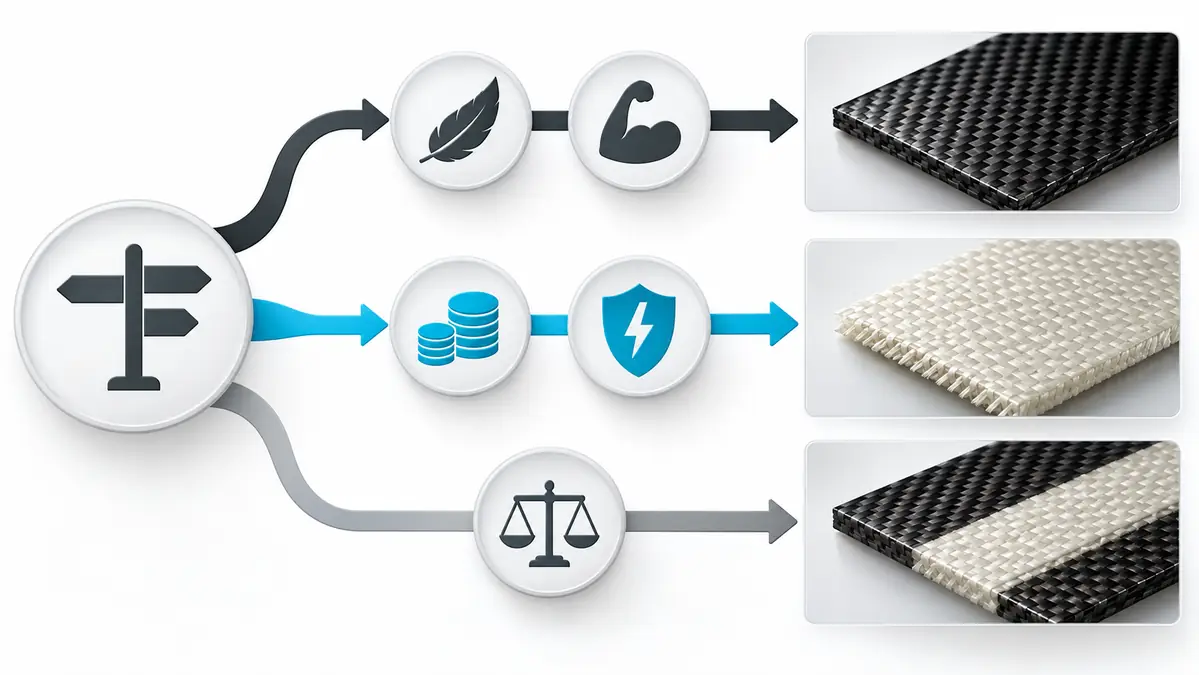
Choose carbon fiber when weight, stiffness, dimensional stability, or premium exposed appearance creates enough system value to justify higher material and process costs. Choose fiberglass when affordability, electrical insulation, RF transparency, strain capacity, and forgiving impact behavior lead the requirement. Consider a hybrid laminate when performance is concentrated in specific load paths.
The most reliable choice comes from comparing manufacturable laminate concepts against the same requirements, then validating a representative part. Noah Composites supports material selection, DFM, tooling, prototyping, molding, machining, inspection, and production for custom CFRP and GFRP projects.