A Carbon Fiber Boat Ladder makes boarding, swimming and reboarding easier without adding the handling burden of a heavy metal assembly. For a tender, sailing yacht, motor yacht or performance boat, however, a ladder must do more than look lightweight. It needs comfortable geometry, reliable grip, a secure boat interface, corrosion-managed hardware and a validation plan matched to its intended use.
This guide explains how to specify a custom ladder, compare configurations and prepare an OEM project. Noah Composites can provide OEM and ODM Carbon Fiber Boat Ladder manufacturing, including DFM, tooling, prototype builds, carbon components, bonded assembly, hardware integration, finishing, inspection and repeat production.
Quick answer: select a Carbon Fiber Boat Ladder by use case, boarding height, deployed angle, usable rung depth below the water, handhold geometry, attachment method, storage envelope and verified load—not by weight alone.
Carbon Fiber Boat Ladder Design at a Glance
| Decision | Inputs to define | Why it matters |
|---|---|---|
| Primary use | Swimming, emergency reboarding, side boarding, tender access or dock boarding | Changes geometry, deployment, handholds and applicable requirements |
| Boat interface | Transom, swim platform, bulwark, cap rail or dedicated deck sockets | Controls load transfer and custom fittings |
| Geometry | Width, rung spacing, deployed angle, waterline depth and handrail height | Determines comfort and whether users can climb without assistance |
| Structure | Design load, dynamic factor, side load, torsion, fatigue and impact cases | Drives laminate, joints, fittings and validation |
| Surface | Flat or shaped rungs, anti-slip finish, drainage and barefoot comfort | Supports secure footing in wet conditions |
| Deployment | Fixed, removable, folding, telescopic or sectional | Affects speed of use, storage volume and moving joints |
| Environment | Saltwater, UV, temperature, cleaners and immersion duration | Guides resin, coating, adhesive, isolation and maintenance choices |
| Production | Annual quantity, finish class, documentation and target cost | Determines tooling and manufacturing route |
Which Type of Carbon Fiber Boat Ladder Do You Need?
The phrase “boat ladder” covers products with different functions. Defining the function first prevents a visually attractive design from being used in the wrong operating condition.
Swim and reboarding ladder
A swim ladder connects the water to a swim platform or deck. It should be deployable without awkward lifting, offer secure grip when wet and provide useful lower rungs for a person starting in the water. If it is the boat’s designated means of reboarding, the boat builder must evaluate the complete arrangement against the applicable requirements—not just the ladder as a loose component.
Side boarding ladder
A side ladder supports transfer between a dock, tender or quay and a yacht’s side deck. It may need hull stand-offs, a variable angle, tall handrails and protection where the ladder touches painted surfaces. Freeboard and tide variation can make a custom configuration essential.
Boarding stairs and sea stairs
Wider self-leveling steps, guardrails, wheels or landing platforms move the product into boarding-stair territory. These systems can be easier for guests but are larger, heavier and more complex. They should not be treated as a simple stretched swim ladder.
Tender and performance-boat ladder
Small craft often prioritize low mass, rapid removal and compact stowage. The ladder may have only a few rungs, yet the interface still has to resist twisting and avoid local damage to a thin deck or transom laminate.
Noah’s custom carbon fiber marine products capability can support these configurations as OEM projects when design inputs and acceptance requirements are clearly defined.
Why Choose a Carbon Fiber Boat Ladder?
A Carbon Fiber Boat Ladder is most valuable when low handling mass, stiffness, appearance and custom integration justify a composite structure. On a larger yacht, reduced weight can make a long ladder easier for crew to deploy. On a small performance boat, it can reduce weight at the transom and simplify removal.
- High specific stiffness: properly oriented fibers can produce rigid rails and rungs at low mass.
- Corrosion-resistant composite structure: carbon laminates do not rust, although attached metals still require isolation.
- Premium appearance: exposed weave, painted yacht colors and teak or composite tread inserts are possible.
- Geometry freedom: curved rails, integrated hard points, folding joints and boat-specific stand-offs can be engineered into the product.
- Handling and storage: a lighter assembly is generally easier to carry, deploy and retrieve.
Carbon fiber is not a guarantee of safety or minimum weight. Poor fiber orientation, under-designed joints, slippery rungs or incompatible hardware can cancel its benefits. Compare completed systems under the same load, geometry and test criteria.
Carbon Fiber Boat Ladder vs Aluminum and Stainless Steel Ladders
| Criterion | Carbon-fiber composite | Aluminum | Stainless steel |
|---|---|---|---|
| Handling mass | Can be very low for a stiffness-driven design | Moderate | Usually highest |
| Stiffness strategy | Fiber orientation and section geometry can be tailored | Relies on alloy and section size | High modulus but significant density |
| Marine corrosion | Composite does not rust; metal interfaces require galvanic isolation | Needs alloy, coating and galvanic control | Good with the correct grade and oxygen exposure; crevices still matter |
| Finish | Clear carbon weave or painted yacht finish | Anodized, painted or powder-coated | Polished or brushed |
| Custom shapes | Excellent with dedicated tooling | Efficient for bent and welded forms | Efficient for fabricated tube structures |
| Repair and inspection | Requires composite-specific procedures | Familiar metal repair methods | Familiar fabrication, though field repair may distort finish |
The right answer depends on the product position. Stainless may fit a compact standard ladder. Aluminum may be cost-effective for a simple frame. A Carbon Fiber Boat Ladder becomes compelling when the brand needs a lightweight, stiff, custom and visually premium boarding solution.

How to Size a Carbon Fiber Boat Ladder
Do not copy one catalog model and scale it uniformly. A safe, comfortable Carbon Fiber Boat Ladder starts with the person, waterline, boat geometry and deployment condition.
Measure the full boarding path
Record the vertical distance from the boarding deck to the expected waterline across relevant loading conditions. For side boarding, include dock height, tidal range, fenders and hull curvature. For a tender, capture tube or gunwale geometry and the location where a user’s knee or foot may contact the boat.
Provide useful depth below the water
A lower rung that barely touches the water may force a swimmer to lift a knee too high. Current requirements and regional guidance may define reboarding geometry. For example, ABYC explains that its H-41 update increased the required reboarding-ladder depth from 12 inches to 22 inches below the water, based on testing supported by the U.S. Coast Guard. Read the ABYC reboarding update and confirm the current full standard for the target boat and market.
Set rung width, spacing and tread shape together
Rung spacing should feel consistent throughout the climb. A wide, flat tread can be more comfortable barefoot than a small round tube, but it adds bending and joint requirements. Rounded edges, drainage and a replaceable anti-slip surface can improve comfort and serviceability. Validate the final geometry with representative users rather than relying only on CAD.
Extend handholds through the transition
The most difficult part of boarding is often moving from the top rung onto the deck. Handrails need useful height, clearance and grip through that transition. Check for interference with gates, hatches, cushions and railings. If handrails are removable, their locks must be obvious and resistant to unintended release.
Safety and Reboarding Requirements
ISO 15085:2024 addresses protection from falling overboard and means of reboarding on small craft. Its scope includes design, construction and strength requirements intended to facilitate unaided reboarding. The standard also covers topics such as slip-resistant surfaces and handholds. The official ISO 15085:2024 overview is a useful starting point, but the responsible party must obtain and apply the complete current requirements to the Carbon Fiber Boat Ladder and boat-level arrangement.
ABYC lists H-41, Reboarding Means, Ladders, Handholds, Rails, and Lifelines among its hull-and-deck standards. Standards, regulations and certification requirements vary with boat size, intended use, flag, sales market and whether the Carbon Fiber Boat Ladder serves as required safety equipment.
No article or component supplier can approve the boat-level arrangement in isolation. Identify the compliance owner, classification or certification body where applicable, test evidence and installation responsibility at the start of the project.
Structural Design: Rails, Rungs and Joints
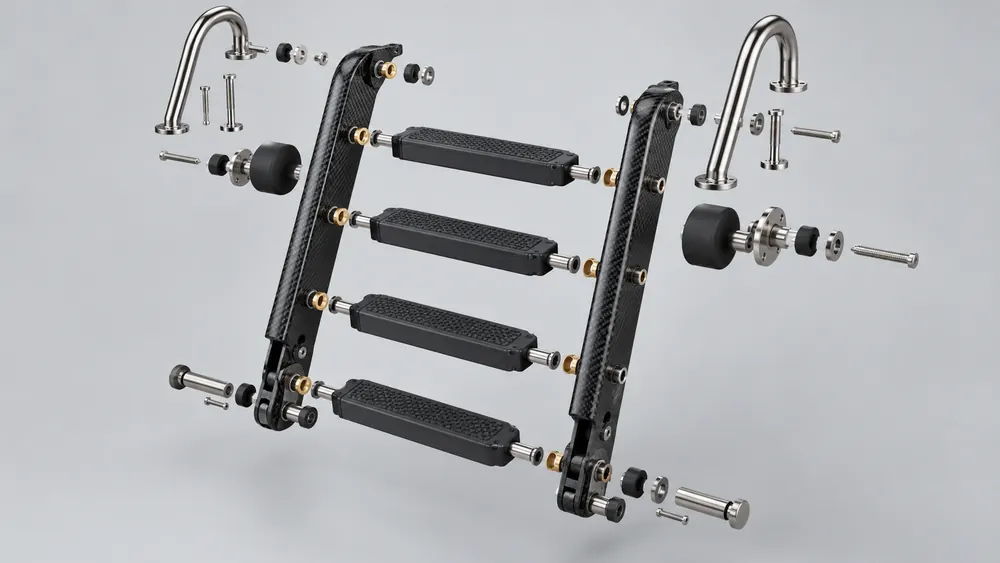
The main rails of a Carbon Fiber Boat Ladder carry bending and compression while also resisting torsion as the user loads one side. Rungs carry transverse bending and transmit load into both rails. Deck pins, hooks or sockets then pass those forces into the boat. The entire path needs defined load cases.
Laminate design follows load paths
Unidirectional fibers can support axial and bending loads in the rails. ±45° plies help carry shear and torsion, while woven outer plies can improve handling and surface continuity. Curves, holes and joints may require local reinforcement. See Noah’s guide to carbon fiber layup design for more detail on fiber orientation and ply transitions.
Rung connections need peel-resistant geometry
Bonding a rung to the side of a thin rail with a small adhesive footprint can create high peel stress. Better designs increase overlap, use shaped sockets or co-molded features, and keep bond-line thickness controlled. Mechanical retention may supplement bonding where the engineering and service strategy require it.
Hard points protect composite interfaces
Deck pins, hinges and latches create concentrated bearing loads. Composite or metallic inserts need adequate embedment, anti-rotation features and sealed edges. Water must not enter a hollow rail or core through a fastener hole. Precision carbon fiber CNC machining can help control trimmed edges and hole locations, followed by appropriate sealing.
Carbon Fiber Boat Ladder Wet Grip and Barefoot Comfort
Every usable rung on a Carbon Fiber Boat Ladder needs a slip-resistant surface suitable for wet feet. Options include textured composite, bonded elastomer, molded tread inserts, synthetic decking or teak. Evaluate grip when wet and contaminated with sunscreen, salt or fine sand. A deep aggressive texture can improve traction yet become uncomfortable or difficult to clean.
Water should drain freely from treads, sockets and folding cavities. Avoid hidden cups that trap seawater against fasteners. Replaceable tread pads need a defined adhesive, surface-preparation method and removal procedure that will not damage the structural laminate.
Prevent Galvanic Corrosion on a Carbon Fiber Boat Ladder
Carbon fiber is electrically conductive and relatively noble. Direct carbon contact can accelerate corrosion of aluminum and some other metals in a saltwater electrolyte. A durable Carbon Fiber Boat Ladder therefore needs a documented isolation system, not merely “marine-grade hardware.”
- select suitable stainless steel or titanium where justified;
- separate dissimilar materials with nonconductive bushings, sleeves, coatings or laminate barriers;
- seal fastener paths and prevent persistent saltwater crevices;
- avoid cutting through protective layers during installation; and
- include interface inspection in the maintenance instructions.
The exact stack-up should appear in controlled drawings. For more context on fibers, resins and formats, review Noah’s carbon fiber material overview.
Mounting, Folding and Storage Options
A removable Carbon Fiber Boat Ladder may use deck sockets, spring-loaded pins, hooks, quick-release fittings or custom brackets. The attachment should engage positively, show whether it is locked and avoid loose hardware that can be dropped overboard.
Fixed and folding
A fixed Carbon Fiber Boat Ladder is always available but may create drag, interfere with docking or remain immersed. A folding lower section can stay installed while lifting clear of the water. Hinges and latches then become fatigue- and pinch-point-critical parts that need testing and inspection access.
Removable and sectional
A removable ladder keeps the hull clean and can be stored in a dedicated bag or cradle. Sectional designs reduce stowed length but add joints. Each joint needs alignment, retention, stiffness and a simple deployment sequence that works on a moving boat.
Telescopic
Telescopic rails can provide compact storage, but sliding carbon surfaces, drainage, sand contamination, stops and locking mechanisms require careful development. A lightweight concept is only successful if crew can deploy it quickly and verify that every section is locked.
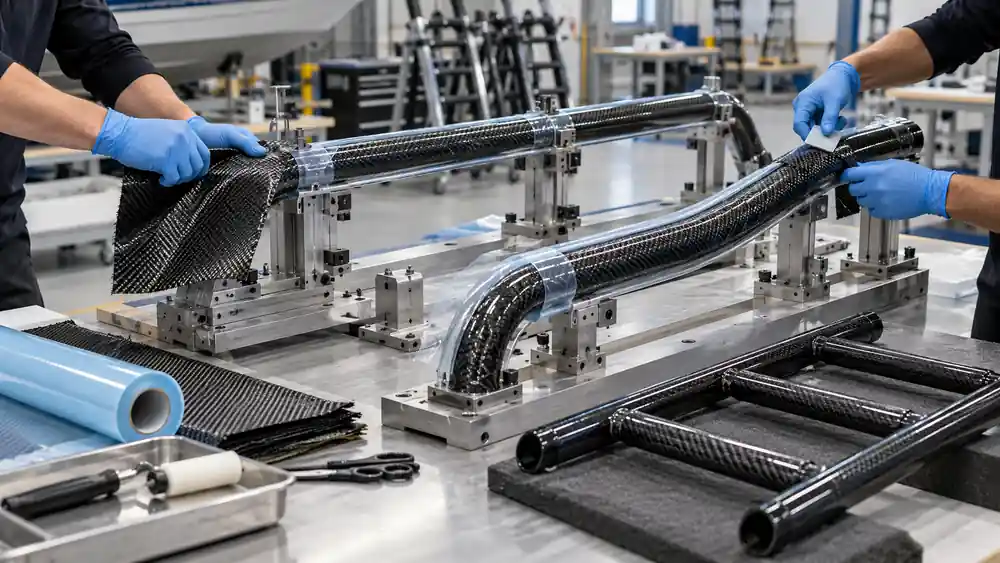
How an OEM Carbon Fiber Boat Ladder Is Manufactured
Noah Composites can develop a custom Carbon Fiber Boat Ladder from customer CAD or a performance specification. The manufacturing route depends on geometry, finish, volume and test requirements.
- Requirements capture: define boat interface, operating modes, user range, loads, waterline, storage, finish and target markets.
- Concept and DFM: select rail sections, rung geometry, joints, hard points, hardware isolation and assembly sequence.
- Engineering definition: establish laminate, bonding, tolerances, drawings, acceptance criteria and verification plan.
- Tooling: produce rail and rung molds, trim fixtures, drilling fixtures and bonding jigs.
- Prototype: build a first article for fit, deployment, ergonomic and structural evaluation.
- Validation: perform agreed dimensional, proof-load, fatigue, corrosion or environmental tests.
- Production: control materials, layup, cure, surface preparation, bond gaps, assembly and final inspection.
Prepreg and autoclave manufacturing can support high fiber control and premium cosmetic surfaces. Other vacuum-bagged or molded routes may fit different shapes and quantities. The best process is the one that consistently meets the drawing and validation plan at the required production rate.
Noah Composites OEM and ODM Services
Noah Composites can OEM a Carbon Fiber Boat Ladder for yacht builders, boat manufacturers, marine-equipment brands and distributors. Support can include CAD and DFM review, laminate development, molds, prototypes, rail and rung manufacture, controlled bonding, inserts, hinges, deck fittings, anti-slip tread integration, painted or exposed-carbon finish, inspection records and packaging.
An ODM project can begin with functional inputs, while an OEM build can follow customer-controlled drawings and specifications. In either case, responsibilities for compliance, boat-level installation approval, user instructions and final validation should be agreed in writing. Learn more about Noah’s custom composite products and carbon fiber manufacturing capabilities.
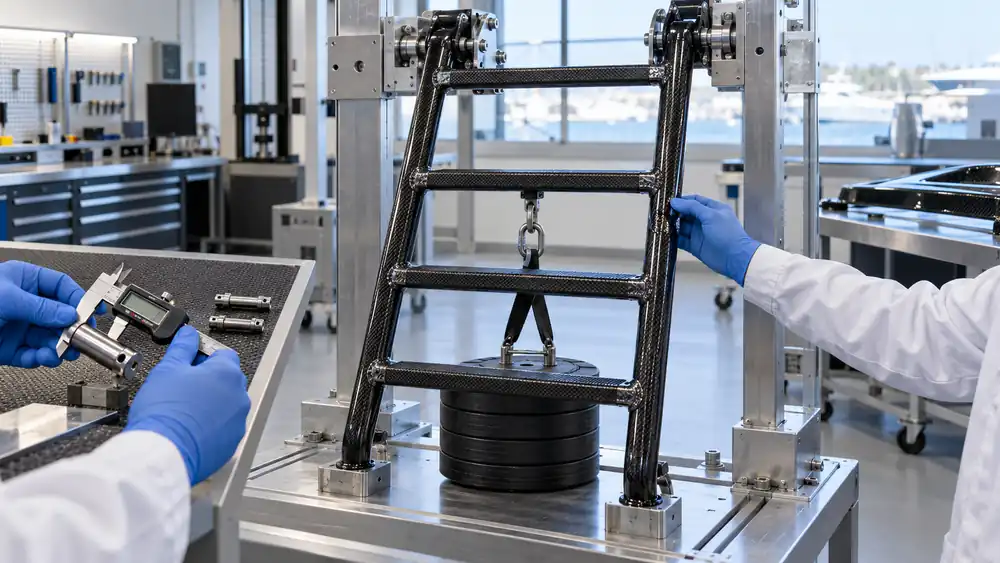
Quality Control and Validation
A production ladder needs repeatable evidence, not only a successful demonstration sample. A project-specific control plan may include:
- overall length, width, rung spacing, deployed angle and mounting-point geometry;
- finished mass and stowed dimensions;
- material batch, freezer-life and cure-record traceability where applicable;
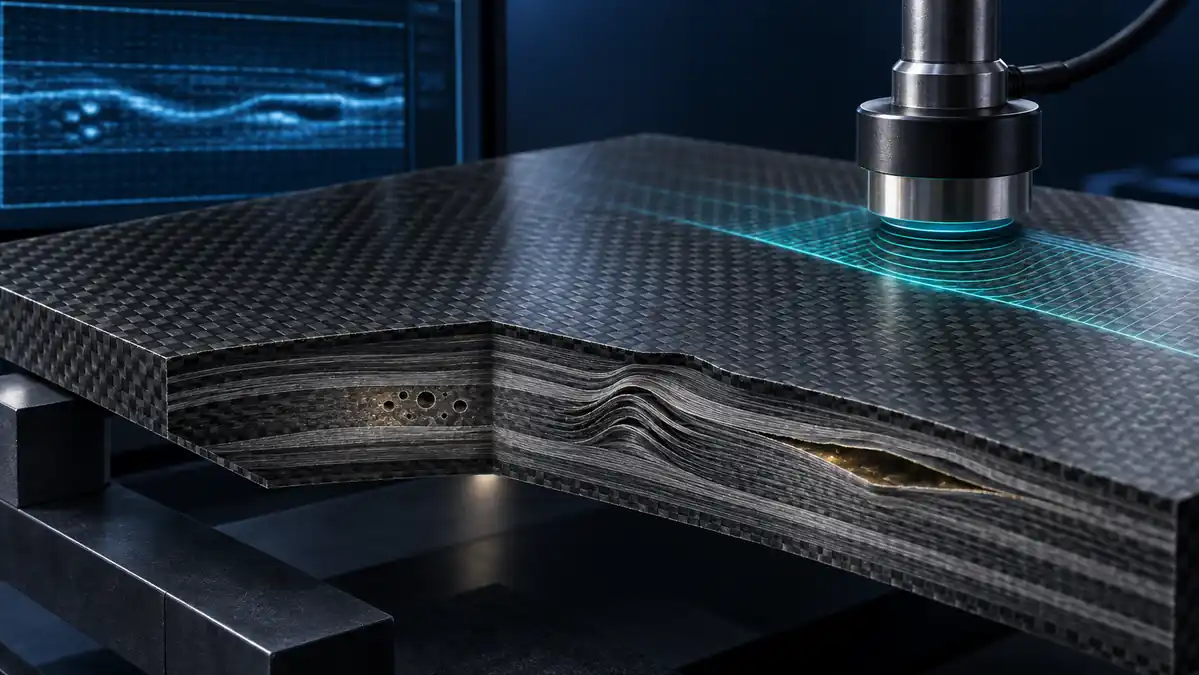
- laminate, surface, void, wrinkle and edge-sealing inspection;
- bond preparation, bond-line gap and adhesive cure verification;
- insert, pin, hinge, latch and handrail retention checks;
- rung and whole-ladder proof loads in representative directions;
- torsion, cyclic use, impact or misuse cases required by the risk assessment;
- wet slip and ergonomic checks with representative users; and
- saltwater, UV, temperature or corrosion testing when specified.
Acceptance criteria should define permissible deflection, permanent set, joint movement and visual damage. If a prototype fails, the corrective action must flow back into the drawings and process controls. Noah’s article on carbon fiber defects and quality control explains common manufacturing risks and inspection methods.
Carbon Fiber Boat Ladder Installation and Maintenance
Confirm deck or transom strength before drilling a Carbon Fiber Boat Ladder installation. Use the specified backing structure, sealant, isolation parts, fastener grade and torque. The ladder should deploy without fouling trim tabs, outboards, steering gear, platforms or tender equipment. Its stowed arrangement must not block emergency access.
After use, rinse salt and sand with fresh water and allow cavities to drain. Use cleaners approved for the finish. Inspect anti-slip surfaces, pins, latches, sockets, bumpers, bond lines and coatings at defined intervals. Remove the ladder from service after a significant impact, overload, unexplained movement or visible structural damage until a qualified assessment is completed.
12-Point RFQ Checklist for a Custom Carbon Fiber Boat Ladder
Provide the following information for an accurate OEM quotation:
- boat type, model, deck/transom drawings, photos and 3D data;
- primary use and whether the ladder is a designated reboarding means;
- minimum and maximum deck-to-water or dock height;
- target width, rung count, spacing, angle and handrail envelope;
- user range, design loads and responsible engineering authority;
- fixed, folding, removable, sectional or telescopic configuration;
- mounting structure, backing access and permitted interfaces;
- tread material, wet-grip, barefoot-comfort and drainage expectations;
- finish, weave, color, gloss, UV and corrosion-isolation requirements;
- stowed envelope, deployment time and storage bag or cradle;
- tests, documentation, standards and sales markets; and
- prototype quantity, annual volume, target schedule and packaging.
Frequently Asked Questions
Can Noah Composites manufacture a custom Carbon Fiber Boat Ladder?
Yes. Noah Composites can provide OEM or ODM engineering and production support, from DFM and tooling to prototypes, hardware integration, finishing, inspection and serial manufacture. The scope is tailored to the customer’s design maturity and compliance plan.
Is a carbon fiber ladder lighter than an aluminum ladder?
It can be, especially when stiffness drives the design and fiber orientation is optimized. A fair comparison must use the same length, width, load, deflection, hardware and safety requirements. Carbon is not automatically lighter if the geometry or joints are inefficient.
How many rungs should a boat ladder have?
Rung count follows the deployed vertical distance, rung spacing, waterline and applicable reboarding requirements. The lower usable rung and upper handhold transition matter more than an isolated rung count.
Can a Carbon Fiber Boat Ladder be foldable or removable?
Yes. It can be fixed, folding, sectional, telescopic or fully removable. Moving joints and quick-release hardware need positive locking, drainage, corrosion control and validation for repeated use.
Can carbon fiber contact stainless steel or aluminum?
Carbon may be paired with suitable metals, but the interface must be engineered. Direct carbon-to-aluminum contact in saltwater is especially risky because of galvanic corrosion. Use a documented isolation, sealing and inspection system.
Does the ladder need a non-slip tread?
Yes. Wet grip is a core safety requirement. The chosen tread should also be comfortable for bare feet, drain freely, resist UV and cleaning chemicals, and be replaceable without damaging the structural rung.
Is every custom ladder automatically compliant with ISO or ABYC?
No. Applicability depends on the boat, market and function. Compliance requires the current complete standard, boat-level integration and specified evidence. It should never be inferred from the use of carbon fiber or from a generic design.
Plan the Ladder as Part of the Boat
A successful Carbon Fiber Boat Ladder combines light handling with comfortable geometry, secure wet grip, durable joints and a boat interface that transfers load safely. The best time to define mounting, storage and validation is before tooling—not after the first cosmetic part is complete.
Prepare the boat geometry, waterline range, use cases, target configuration, finish and production volume. Then contact Noah Composites to discuss an OEM Carbon Fiber Boat Ladder prototype and scalable production plan.