A Carbon Fiber Boat Steering Wheel can reduce helm inertia, improve handling and create a distinctive premium cockpit. Those benefits only become real when wheel diameter, rim geometry, spoke stiffness, hub interface and steering-system loads are engineered together. A lightweight wheel with the wrong taper, poor wet grip or an under-designed hub is not a safe upgrade.
This guide explains how boat builders and marine brands can specify a custom wheel and organize an OEM program. Noah Composites can provide OEM and ODM Carbon Fiber Boat Steering Wheel manufacturing, including DFM, tooling, prototypes, laminate production, hub integration, cosmetic finishing, inspection and repeat production.
Quick answer: select a Carbon Fiber Boat Steering Wheel by steering-system interface, wheel diameter, helm loads, cockpit clearance, grip, finish and verified test requirements—not by appearance or weight alone.
Carbon Fiber Boat Steering Wheel Design at a Glance
| Decision | Required inputs | Why it matters |
|---|---|---|
| Boat and helm | Sailboat, catamaran, powerboat, steering type and helm location | Defines diameter, spoke layout, rim section and environment |
| Wheel diameter | Reach, seat position, visibility and cockpit clearance | Changes leverage, rotation envelope and ergonomics |
| Hub interface | Shaft diameter, taper, key, thread, nut and steering-system drawing | Determines whether the wheel mounts and transfers torque correctly |
| Structural loads | Steering torque, rim load, spoke load, misuse, impact and fatigue | Drives laminate, hub reinforcement and validation |
| Grip | Rim diameter, shape, wet friction, gloves and trim | Affects control and comfort in wet conditions |
| Finish | Exposed weave, paint, gloss, UV and cosmetic class | Protects the laminate and aligns with yacht styling |
| Production | Annual volume, branding, documentation, tests and target cost | Guides tooling, process and quality plan |

Sailboat vs Powerboat Carbon Fiber Boat Steering Wheel
The same core keyword covers two quite different products. Defining the boat and helm arrangement first prevents incorrect assumptions about size, force and interface.
Large sailboat steering wheel
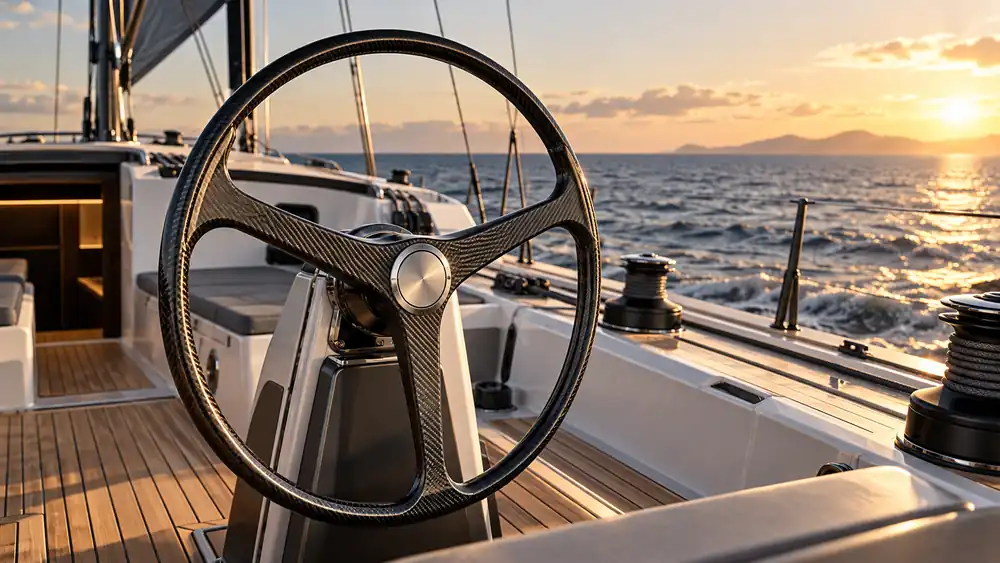
A sailing yacht may use a large-diameter wheel so the helmsperson can reach it from different cockpit positions and gain useful mechanical leverage. The rim is often slender, with three to five spokes and a central hub sized for the steering shaft. Twin-wheel cockpits add port/starboard fit and visual-symmetry requirements.
For a large Carbon Fiber Boat Steering Wheel, reducing mass away from the axis can reduce rotational inertia. The practical result may be a more responsive feel. The steering system, rudder loads and autopilot must still be evaluated as one system.
Compact powerboat steering wheel
Powerboats commonly use a smaller wheel with a thicker grip, three spokes and a central mounting pattern or tapered-shaft hub. It may include leather, elastomer, a spinner knob or color accents. The seated position, dashboard visibility and hand clearance around throttles and displays are key constraints.
Structural carbon versus carbon-look trim
Some marine products use a steel or plastic structure with a printed carbon pattern. That may satisfy styling, but it should not be confused with a structural Carbon Fiber Boat Steering Wheel. An OEM specification must state whether the rim and spokes are load-bearing carbon composite, decorative carbon skin over a core, or only a visual finish.
Noah’s custom carbon fiber marine products capability supports boat builders and marine brands that need a product designed for a specific vessel or range.
Why Choose a Carbon Fiber Boat Steering Wheel?
A Carbon Fiber Boat Steering Wheel is attractive when low mass, stiffness, design freedom and premium appearance matter. The strongest business case combines several benefits rather than relying on one headline weight number.
- Low polar inertia: removing mass from the outer rim has a larger effect than removing the same mass near the hub.
- Tailored stiffness: fiber direction can support rim bending, spoke loads and torque transfer.
- Design freedom: thin spokes, curved transitions and integrated branding can be molded into the geometry.
- Marine durability: carbon does not rust, although resin, coatings, hubs and fasteners still need environmental control.
- Premium finish: clear-coated twill, matte carbon, painted yacht colors, leather and hybrid trim are possible.
Carbon fiber does not automatically make a better wheel. The product must maintain specified stiffness and strength, fit the shaft, remain controllable when wet and withstand UV, salt and repeated handling.
Carbon Fiber Boat Steering Wheel vs Stainless Steel or Aluminum
| Criterion | Carbon composite | Stainless steel | Aluminum |
|---|---|---|---|
| Mass and inertia | Excellent potential, especially at large diameter | Usually highest mass | Moderate to low |
| Stiffness strategy | Tailored through fibers and geometry | Predictable isotropic behavior | Predictable, often needs larger sections |
| Corrosion | Composite does not rust; hub needs isolation | Good with correct grade and detailing | Requires coating and galvanic management |
| Styling | Highly customizable molded geometry | Classic polished appearance | Painted, anodized or wrapped |
| Repair | Composite-specific assessment | Familiar metal repair | Familiar fabrication |
The comparison must use the same diameter, hub, stiffness, load and test requirements. A lighter but flexible wheel is not equivalent to a heavier qualified wheel.
How to Select Carbon Fiber Boat Steering Wheel Diameter
Wheel diameter affects reach, leverage, rotation envelope, instrument visibility and cockpit movement. A new Carbon Fiber Boat Steering Wheel should fit the actual helm station, not only the steering shaft.
Measure seated and standing reach
Record the helmsperson’s expected eye point, shoulder location and hand reach in seated and standing positions. Check access to upper and lower rim, passage behind the wheel, and whether knees contact the rim or spokes. On sailing yachts, confirm reach from windward and leeward positions.
Check the complete rotation envelope
Model the full circle against seats, coamings, engine controls, brake knobs, chartplotters, switches and access panels. If the wheel is removable, include quick-release or nut clearance and a safe storage location.
Do not confuse diameter with steering ratio
A larger wheel increases hand leverage, but the complete steering system determines rudder response and force. Cable, chain, hydraulic, mechanical and electronic systems have different interfaces. The boat builder or steering-system authority should approve the combination.
Carbon Fiber Boat Steering Wheel Hub Compatibility
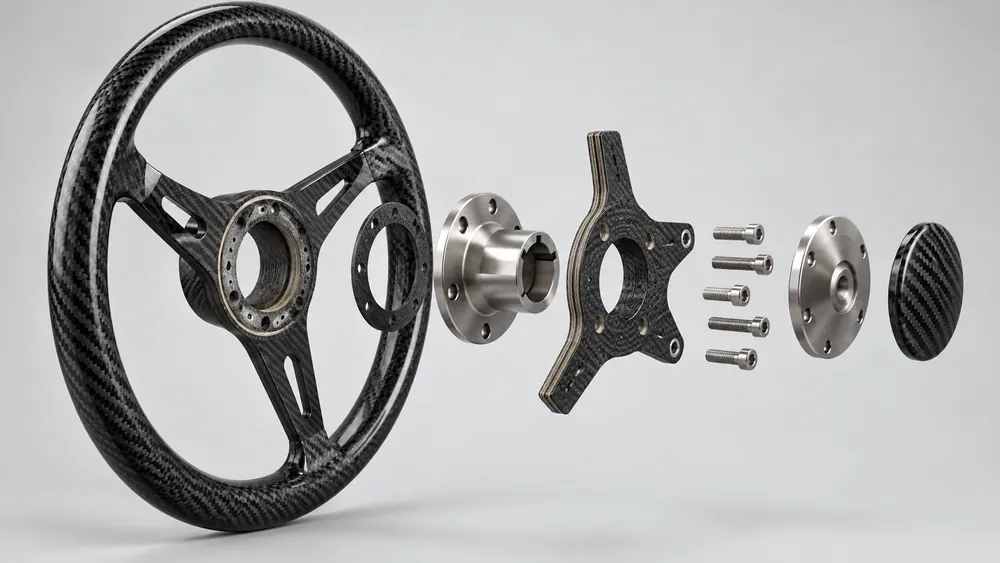
The hub is the most important interface on a Carbon Fiber Boat Steering Wheel. “Fits a 25 mm shaft” is not enough. A drawing or verified sample should define shaft diameter, taper angle or ratio, key dimensions, thread, retaining nut, washer, axial position and any brake or spinner components.
Standard and custom hubs
Marine steering systems may use inch or metric tapered shafts, straight splines, keyed interfaces or brand-specific adapters. A standard hub reduces development time when all dimensions match. A custom hub is a controlled structural component with material, machining, corrosion protection and inspection requirements.
Control runout and concentricity
Hub location affects rim runout and perceived quality. Tooling and bonding fixtures must control the hub relative to the molded rim. The finished wheel may require axial runout, radial runout, bore geometry, key location and mounting-face checks.
Isolate carbon from vulnerable metals
Carbon fiber is conductive and relatively noble. Direct contact with aluminum in saltwater can accelerate galvanic corrosion. Use a documented system of compatible material, coating, adhesive, nonconductive barrier, sealant and drainage. Cosmetic clear coat alone is not a robust isolation strategy.
Structural Design: Rim, Spokes and Hub Zone
A Carbon Fiber Boat Steering Wheel carries off-axis hand loads, steering torque, pulling, pushing, impact and repeated cyclic input. The rim distributes hand load, the spokes carry it inward and the hub transfers torque to the steering shaft.
Rim construction
The rim may be a hollow molded section, foam-cored structure or wrapped tube integrated with the spokes. Longitudinal fibers support bending around the wheel, while off-axis plies help carry torsion and maintain shape. Grip inserts or seams must not create weak transitions.
Spoke load paths
Spokes need continuous fibers or engineered overlaps into rim and hub. Abrupt cutouts, decorative holes and sharp internal corners concentrate stress. Use generous radii and ply transitions that can be manufactured without bridging or wrinkles.
Hub reinforcement
The central region experiences bearing, torque and fastener loads. It often needs extra ±45° and hoop reinforcement, a shaped insert and controlled adhesive geometry. Review carbon fiber layup design for how fiber orientation supports combined loading.
Finite-element analysis can guide design, but material properties, joints and boundary conditions need test correlation. A beautiful rendering is not structural evidence.
Rotational Inertia, Helm Feel and Autopilot Load
Rotational inertia depends on mass and distance from the axis. Because the rim is far from the hub, reducing rim mass can materially change how quickly the wheel accelerates and stops. This may make a large sailboat wheel feel more responsive.
That does not mean the lightest Carbon Fiber Boat Steering Wheel always produces the best helm feel. Steering friction, backlash, rudder balance, hydraulic characteristics and autopilot control dominate many installations. Define mass and inertia only when they support a boat-level objective.
Never claim a specific autopilot energy saving without testing the actual steering system and duty cycle. Validate compatibility with steering-system and autopilot suppliers.
Carbon Fiber Boat Steering Wheel Grip and Marine Finish
A wet helm demands reliable grip. Rim diameter and cross-section should suit expected hand size and gloves. Options include textured clear coat, molded texture, leather, synthetic wrap or soft-touch zones. Each affects durability, cleaning, repair and branding.
A glossy Carbon Fiber Boat Steering Wheel can look striking but may show fingerprints and become slippery or hot in direct sun. Matte or textured zones may improve function. Validate wet friction and comfort with representative users rather than judging only showroom appearance.
The resin and cosmetic carbon need UV protection. Define gloss, weave alignment, print-through, pinholes, color variation and allowable cosmetic defects. A cover can reduce exposure when not in use. See Noah’s carbon fiber material guide for additional context.
Standards and Compliance Responsibilities
ISO 23411:2020 specifies design and testing requirements for steering wheels for small craft. ISO confirmed the edition again in 2026. It is an appropriate starting point for many programs, but the responsible team must obtain the complete current document and confirm applicability.
ABYC lists P-22 Steering Wheels alongside standards for mechanical, hydraulic and electronic steering systems. Target market, vessel type, steering architecture and certification determine which requirements apply.
A Carbon Fiber Boat Steering Wheel manufacturer should not claim material choice alone creates compliance. Define who owns system integration, risk assessment, installation instructions, testing, certification and final boat approval.
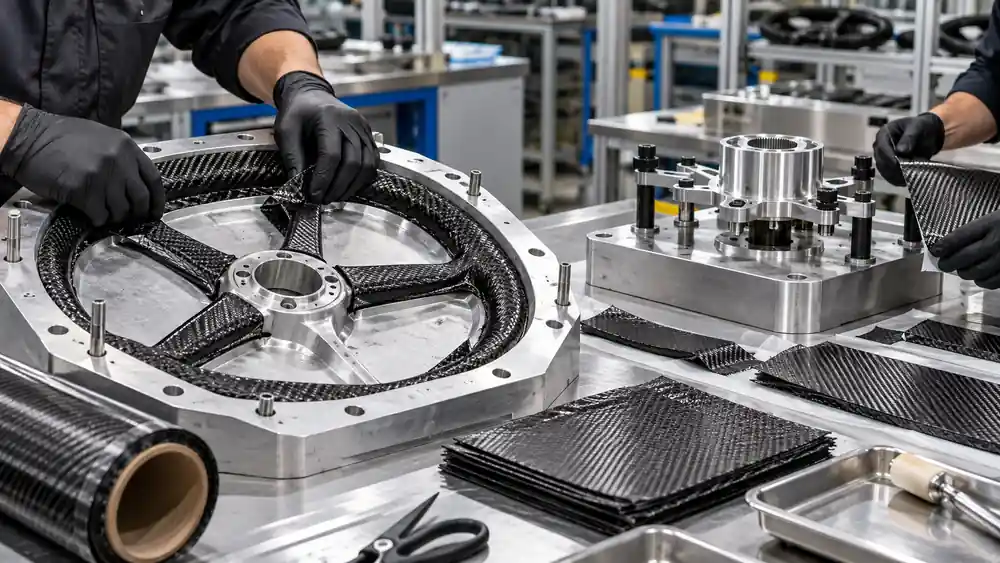
How an OEM Carbon Fiber Boat Steering Wheel Is Made
Noah Composites can manufacture a custom Carbon Fiber Boat Steering Wheel from customer-controlled CAD or develop a manufacturable concept from a performance brief. Process choice depends on size, geometry, cosmetic expectations and annual volume.
- Requirements: collect cockpit data, diameter, hub drawing, loads, finish, standards and production targets.
- Concept and DFM: define rim section, spoke layout, hub reinforcement, laminate, split lines and assembly.
- Tooling: manufacture molds, trim gauges, hub-position and inspection fixtures.
- Prototype: evaluate fit, reach, runout, grip, appearance and structure.
- Validation: perform agreed torque, rim-load, fatigue, impact and environmental tests.
- Production: control material batches, layup, cure, trimming, bonding, finish and inspection.
Prepreg and autoclave manufacturing can support strong process control and premium surfaces. Other closed-mold or vacuum-bagged routes may suit different volumes. Precision carbon fiber CNC machining can support hub bores, trim features and drilling, followed by edge sealing and inspection.
Noah Composites OEM and ODM Capability
Noah Composites can OEM a Carbon Fiber Boat Steering Wheel for boat builders, yacht manufacturers, steering-system brands and marine-equipment distributors. Support may include CAD review, DFM, laminate development, tooling, prototypes, metal hub integration, cosmetic carbon, custom paint, branding, grip preparation, inspection records and packaging.
An ODM project can begin with diameter, cockpit envelope, steering interface and performance requirements. An OEM project can follow customer drawings and approved suppliers. Both benefit from clear ownership of compliance, steering compatibility and final validation. Explore Noah’s custom composite products and carbon fiber manufacturing services.
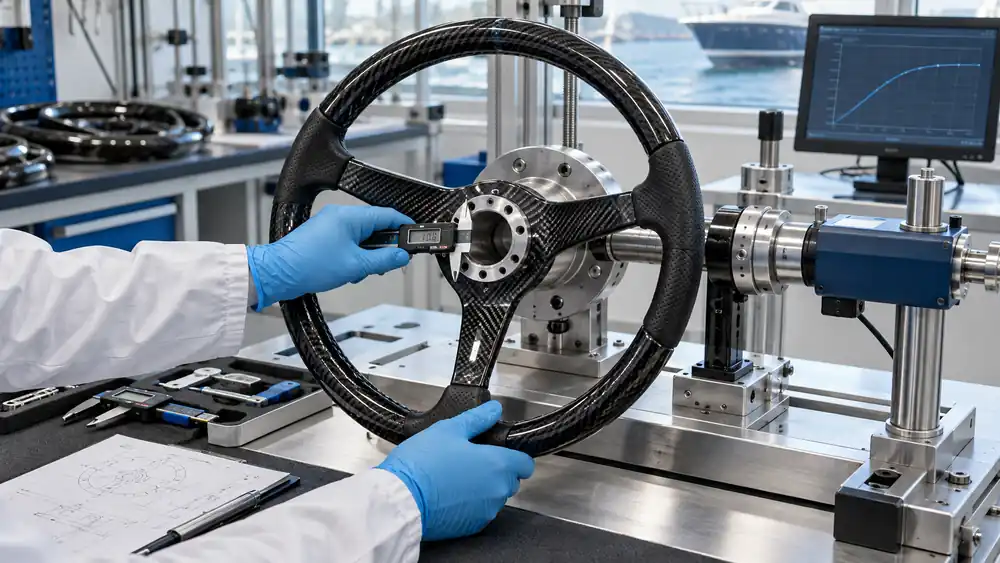
Carbon Fiber Boat Steering Wheel Quality and Testing
A production plan should turn expectations into measurable criteria. Depending on the project, checks may include:
- diameter, rim section, spoke position, hub depth and bolt pattern;
- axial and radial runout after hub installation;
- finished mass, balance and rotational inertia when specified;
- material, layup, cure and adhesive traceability;
- weave, gloss, color, pinholes, print-through and scratches;
- hub-bond preparation, bond-line geometry and cure;
- static torque, rim load and spoke load in representative directions;
- cyclic steering, pull/push misuse and impact cases;
- wet grip, UV, saltwater, temperature and cleaner resistance; and
- post-test inspection for cracks, permanent set and joint movement.
The validation matrix should reference applicable standard clauses without copying them into informal drawings. Routine controls must maintain equivalence to the tested configuration. Noah’s carbon fiber defects and quality control guide explains common laminate and process risks.
Carbon Fiber Boat Steering Wheel Installation and Maintenance
Before installation, verify shaft, key, taper, thread, washer, nut and wheel orientation. Use the steering-system supplier’s torque and retention method. Confirm that the Carbon Fiber Boat Steering Wheel clears the cockpit through full rotation and no spoke obstructs instruments or controls.
Rinse salt with fresh water and use approved cleaners. Inspect the hub, key, nut, brake interface, spoke transitions, rim coating and grip seams. Remove the wheel from service after impact, unexplained looseness, cracking or hub movement until assessed.
10-Point Carbon Fiber Boat Steering Wheel RFQ Checklist
- Boat type, steering system and helm arrangement.
- Target diameter, rim section and spoke count.
- Cockpit envelope, visibility, reach and rotation clearance.
- Complete shaft, taper, key, thread, nut and brake drawing.
- Steering torque, rim loads, misuse cases and engineering authority.
- Structural-carbon versus cosmetic-carbon definition.
- Wet-grip, gloves, leather, soft-touch or spinner needs.
- Weave, paint, color, gloss, UV and branding.
- Standards, tests, reports, traceability and sales markets.
- Prototype quantity, annual volume, schedule and packaging.
These inputs let the OEM quote a defined Carbon Fiber Boat Steering Wheel rather than a visually similar but technically different product.
Frequently Asked Questions
Can Noah Composites manufacture a custom Carbon Fiber Boat Steering Wheel?
Yes. Noah can provide OEM or ODM development and manufacturing, including DFM, molds, prototypes, structural carbon parts, hub integration, finishing, inspection and serial production.
How do I choose the correct wheel diameter?
Measure seated and standing reach, cockpit passage, instrument visibility and full rotation clearance. Diameter affects leverage but does not independently define steering ratio.
Will a carbon wheel fit my existing shaft?
Only if the hub matches the complete interface. Verify taper, diameter, key, thread, nut, axial location and brake features from a drawing or controlled sample.
Is a carbon wheel always lighter than stainless?
It can be, especially at large diameter, but compare the same geometry, hub, stiffness, loads and tests. The finished system determines real mass.
Can the Carbon Fiber Boat Steering Wheel be painted?
Yes. It may use clear carbon, matte carbon, yacht-color paint or mixed finishes. The coating must suit the composite, UV, saltwater and cleaners.
Does carbon fiber corrode in seawater?
The composite does not rust, but conductive carbon can promote galvanic corrosion of aluminum. Engineer materials, barriers, sealing and inspection.
Is ISO 23411 testing automatically included?
No. Applicability and evidence must be agreed for each project. Compliance cannot be inferred from material or appearance.
Build the Wheel Around the Helm System
The best Carbon Fiber Boat Steering Wheel is not simply the lightest or glossiest. It combines correct ergonomics, a verified hub, efficient load paths, reliable wet grip and repeatable manufacturing. Treating the wheel as part of the steering system is the foundation of a durable OEM product.
Prepare the cockpit envelope, steering-interface drawing, loads, finish and annual volume. Then contact Noah Composites to discuss a custom Carbon Fiber Boat Steering Wheel prototype and scalable production program.